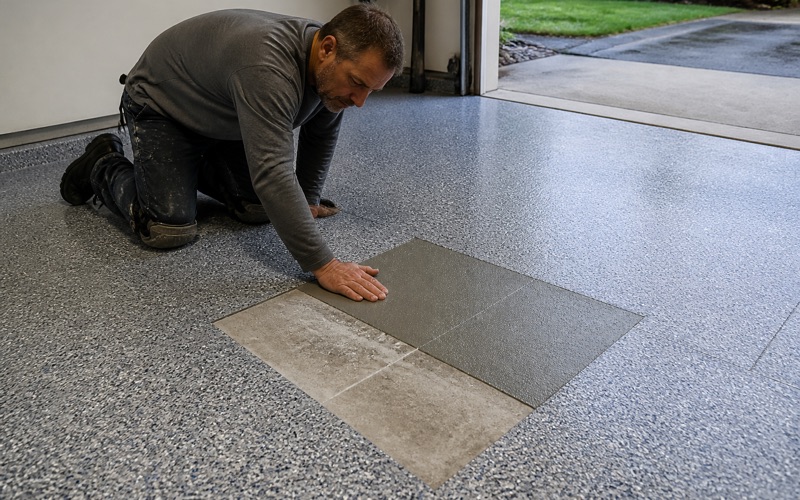
Killeen Epoxy Flooring installs epoxy flooring in Belton, and on the oldest blocks in town the job begins with a question our usual reference cannot answer. Twenty years in this county has taught us to read the soil survey before we quote a crack detail. Around the courthouse square, the survey declines to answer.
That is not a gap in our homework — it is what the published data actually says, and it changes the order of operations. Instead of reading a figure off a map and pricing from it, the slab itself has to be read, and the nearest characterized ground has to stand in for ground that was never characterized.
Everywhere else in the city the survey does answer, and what it says is more specific than the regional story most contractors recite. The ground here is reactive at the surface over a subsoil that is comparatively stable. That is a different animal from deep uniform clay, and it earns a different crack detail.
Where the soil survey stops answering
Urban land, and what that map unit contains
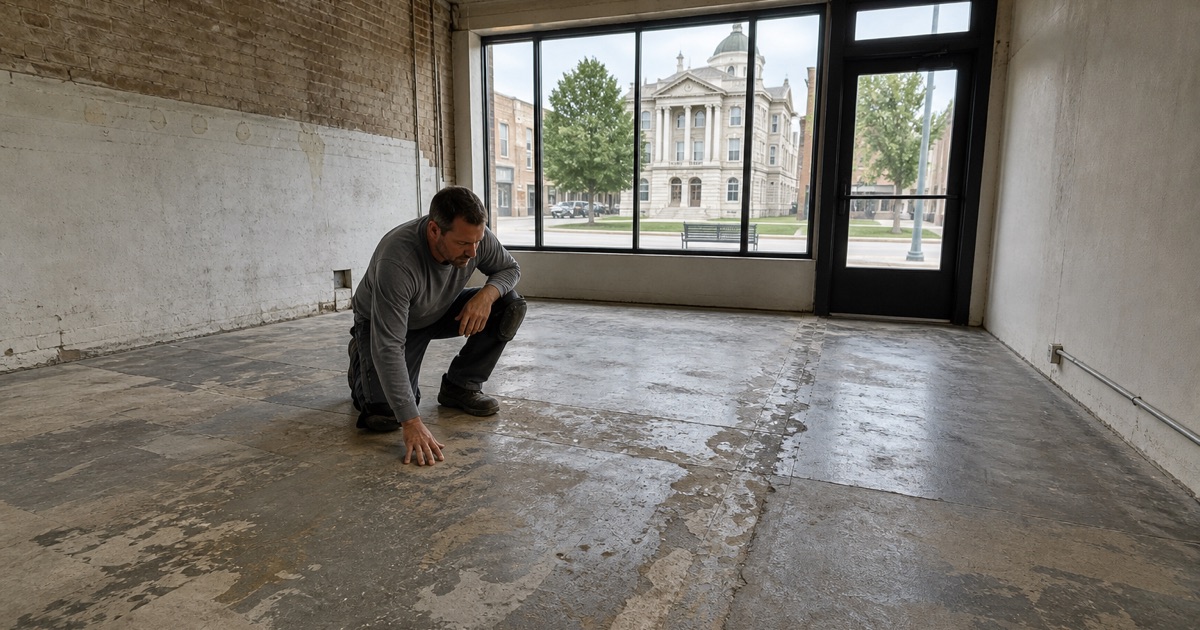
SSURGO at the courthouse block returns Urban land, 0 to 16 percent slopes, with Urban land at 85 percent of the map unit. There is no clay content published for it, no plasticity index and no linear extensibility. On the oldest and most historically significant blocks in the city, the soil survey does not characterize the ground at all.
That is a genuine finding rather than a missing file. Urban land gets mapped where cut, fill, foundations and utilities have disturbed the original profile so thoroughly that a series description would no longer describe what sits under any particular building. The honest response is to stop quoting from the map.
What replaces the number
Three things do the work the map would have done. The first is the surrounding map units, because the characterized ground a block sits between still bounds what the fill under it was borrowed from and what the water around it does.
The second is the building’s own record — what era the slab was poured in, what has been added to it since, whether the floor has ever been cut for plumbing or a grease line, and whether the perimeter has been underpinned. The third is the slab itself, opened and looked at directly, which is the subject of the next section.
Why this changes a quote rather than just a paragraph
A contractor who prices a downtown floor off a regional clay assumption is pricing a crack detail for movement that may not be happening under that particular building, and pricing away a moisture problem that very well may be.
We would rather put an investigation into the scope as a line item than carry a number we cannot support. On a downtown building that usually means a short look before a fixed price, and we say so when we quote rather than afterward.
Looking for epoxy flooring closer to Jarrell? See Jarrell Epoxy Flooring.
Reading an old downtown slab on its own evidence
What the cracks are telling you
A crack that is tight, dry, unstepped and unchanged across two seasons is behaving like shrinkage that finished moving decades ago. A crack with a vertical offset across it, a width that opens and closes with the year, or a crushed repair failing alongside it is a joint that is still working.
That distinction decides the treatment and it cannot be made from a photograph. A working crack is routed, filled with a semi-rigid polyurea joint filler and carried through the coating as a joint, and we tell you before the job that it can show through again. Filled hard and skimmed over, it produces a floor that looks finished and fails along exactly that line.
Moisture goes into the scope, not onto an invoice afterward
Under-slab vapor retarders were not standard practice on older Texas slabs, and moisture vapor emission through concrete is the most common cause of epoxy adhesion failure. On a downtown slab of uncertain age with no published ground data behind it, assuming that a dry-looking floor is dry is the most expensive assumption available.
So calcium chloride testing to ASTM F1869 or in-situ relative humidity probes to ASTM F2170 go into the scope as a line item, read against the ASTM F710 thresholds, with a plastic sheet test to ASTM D4263 as the cheap first look. Where the numbers come back high, a moisture-mitigation primer goes into the build and is priced then — not sold as an extra after a floor has already blistered.
Concrete that is not the concrete on a data sheet
Old commercial slabs in this part of town were placed with different mixes, different finishing practice and different curing than any modern technical data sheet assumes. They are frequently softer, more porous and more variable across one room than a new pour is across an entire building.
Every slab is opened mechanically, to an ICRI CSP profile matched to the system going over it. We do not acid etch and we do not put a new coating over an old sealer. On soft, variable concrete the diamond segment bond hardness has to be chosen for the slab in front of us, because tooling matched to hard concrete will glaze on soft concrete and take nothing off it.
An active surface layer over a stable subsoil, just outside downtown
Denton silty clay is a Mollisol
SSURGO at the city centroid maps Denton silty clay, 1 to 3 percent slopes, with Denton at 85 percent of the map unit — a fine-silty carbonatic thermic Udic Calciustoll, well drained. It is a Mollisol, not a Vertisol, and describing this city as sitting on deep uniform shrink-swell clay is wrong in a way any local reader with a soil map can check.
The distinction is not academic. It changes which part of the profile is moving, and therefore what the slab above it is actually being asked to tolerate.
Twelve percent at the surface, two percent below
The Denton profile runs 50 percent clay with a plasticity index of 37 and linear extensibility of 12 percent from the surface down to 33 centimeters, then 50 percent clay at 10 percent extensibility to 48 centimeters. Below that it changes sharply: 25 percent clay, plasticity index 20 and linear extensibility of only 3 percent from 48 to 91 centimeters, falling to 2.1 percent deeper still.
Read against the standard breaks, the top third of a meter is very high movement and everything under it is low. A slab here sits on an active surface layer over comparatively stable ground, which is a different loading from a deep profile that moves the whole way down.
Practically, that shifts attention to the slab edge. The layer that moves is the one nearest the surface, and what happens to it is decided by perimeter drainage, downspout discharge and irrigation running against the building rather than by anything happening two meters down.
Newer slabs on the same ground
Of Belton’s 8,895 housing units, 42.8 percent date to 2000 or later and 27.5 percent went up in the 2010s alone, the largest single decade by a wide margin. Post-tension slabs became common in Texas after about 1980, which puts most of that newer stock in the post-tension era on ground whose surface layer still moves seasonally.
A post-tension slab cannot be cored, drilled or saw-cut until the tendons have been located, and cutting one is a structural repair rather than a change order. Anchoring a threshold, doweling a transition or cutting a new control joint into a newer garage here is a different operation with a different pre-step than the same work on a 1960s slab.
The upside is that most of those slabs are young, uncoated and in good condition, which is a materially simpler floor to build than an old one. It is also why we say plainly what a coating cannot do: it is a film a few thousandths of an inch thick, it follows the concrete under it, and nothing we install prevents a slab from moving.
Grant money, paperwork, and one date a schedule cannot cross
Facade grant money and why a downtown floor job starts at all
Belton’s Facade Improvement Grant Program, established in 2006, offers 50/50 matching grants up to $10,000 per facade, with a maximum of $20,000 where a building has two street-facing facades. It is worth naming on a flooring page because it is very often the reason a downtown property owner brings a project forward in the first place.
A facade grant does not pay for a floor. What it does is open a work window — scaffolding up, a contractor already mobilized, a tenant space already empty — and a floor that has been waiting ten years gets done inside that window because everything else is disrupted anyway. We would much rather hear about that window early than be squeezed into the end of it.
Registering with the city before an application means anything
Permit applications, plan submissions, inspection requests and permit tracking for the City of Belton all run through the MGO Connect portal, and contractors register with the city through MGO as part of the application procedure. A contractor who has not registered has not started, whatever they have told you about their schedule.
The Planning Department at 333 Water Street is the counter behind the portal. Whether an interior floor coating triggers a permit at all depends on what else is in the scope, so we ask rather than assume — and if a slab needs structural repair before it can be coated we say so, and we tell you that foundation work carries its own permit which a floor coating does not.
One date downtown that a schedule cannot cross
The July 4 parade runs a mile and a half starting at 9 a.m., south on Main Street from the University of Mary Hardin-Baylor to the Bell County Courthouse, east on Central Avenue and north on Birdwell to the Police Memorial, with chamber-estimated attendance above 30,000 in a city of roughly 23,000.
Main Street closes, staging anywhere near the square is impossible, and a downtown storefront job planned across that date loses the day and most likely the days either side of it. On a floor with a return-to-service date tied to a lease or a reopening, that is not a footnote — it is the difference between making the date and missing it.
- 20+ Years Experience
- Insured & City Registered
- Free Estimates