
Killeen Epoxy Flooring has been specifying and installing concrete driveway coating in Killeen, TX for more than 20 years, serving surrounding cities including Fort Hood, Harker Heights, Nolanville, Copperas Cove and Belton. A driveway is the hardest slab on a residential property to coat well, and it is the one most often quoted as though it were a garage with the door left open.
The difference is exposure. A garage slab lives in the shade at a fairly steady temperature, sees one set of tires and never gets rained on. A driveway takes direct sun, thermal cycling, standing water, turning loads and every freeze the season delivers, and each of those pushes the specification in a different direction.
Before any of that is priced, we look at what the slab is sitting on. The ground here is San Saba clay, a smectitic Vertisol near 50 percent clay with a plasticity index of 40 and a linear extensibility around 10 percent, which is a very high shrink-swell rating. An exterior slab on that ground moves seasonally, and how we detail the joints and cracks follows from it.
Why a Driveway Is a Harder Specification Than a Garage
An uncoated driveway takes moisture from both faces. Rain and irrigation wet it from above while ground water pushes vapor up through it from below, and unlike a house slab a driveway has no under-slab vapor retarder at all. Any coating we put on it has to be chosen knowing that vapor drive never stops.
Loading is the other half. A driveway carries turning loads rather than straight rolling ones, which shear the surface far harder than parking does, and the apron at the street sees delivery vehicles and heavier trucks the garage never sees. That pushes mil build up and rules out the thin roll-on systems sold for interior floors.
Hot Tire Pickup on a Sun-Heated Slab
Hot tire pickup is the failure homeowners recognize: two rectangles of missing coating where the car sits. It happens when hot tires soften a thin or under-cured film, then grip it as they cool and lift it away. On an exterior slab the risk is much higher than in a garage, because the concrete under the tire is already hot from the sun before the vehicle ever arrives.
Three things control it. The system needs real mil build rather than a single thin coat, it needs a topcoat rated for vehicle traffic such as a polyaspartic or polyurea over a 100% solids epoxy base, and it needs to reach full cure before cars come back, not just be walkable. Darker colors run hotter in the sun, which is a selection point worth knowing rather than a reason to avoid them.
UV, Ambering and Holding Color Outdoors
Standard epoxy is aromatic, and aromatic resin ambers and chalks under ultraviolet light. Indoors that never shows. On a driveway an epoxy left as the wearing surface will shift yellow within a season and then dull to a chalky film, and no amount of cleaning brings it back.
The answer is an aliphatic topcoat. A polyaspartic or aliphatic polyurea wearing coat holds color and gloss under direct sun and takes the abrasion at the same time, so on an exterior slab it is not an upgrade line on the proposal, it is the system. Where the base coat is epoxy it stays buried under that topcoat and never sees daylight.
Gloss still moves outdoors, more slowly and more evenly than pigment does. A satin sheen ages better than a high gloss on a driveway because it dulls less visibly, and it shows tire scuffing less.
Expansion Joints, Slope and Where the Water Goes
A driveway is not one slab. It is a set of panels separated by control and expansion joints that exist so the concrete can crack where it was told to, and a coating carried across those joints as though they were not there will split within the first temperature swing.
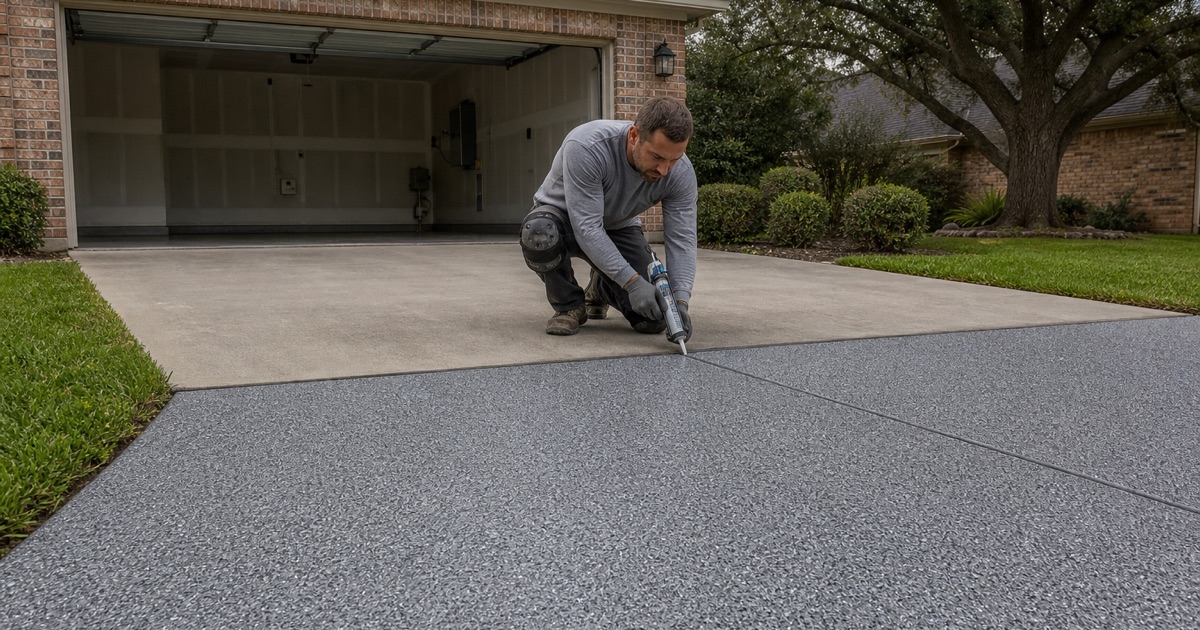
We honor every joint. Working joints and moving cracks are routed and filled with a semi-rigid polyurea joint filler, then carried up through the coating as a joint, and you are told before the job that a joint over moving ground can telegraph again. A coating is a bonded film a few thousandths of an inch thick, it follows the slab exactly, and nothing we install stops or bridges seasonal ground movement.
Drainage decides texture. A driveway is sloped to shed to the street, water runs across it rather than sitting on it, and the low points at the apron and along an edge stay wet longest. Those are the areas that get a heavier aggregate broadcast to raise the coefficient of friction, because a coated slope is genuinely slick under running water.
Weather Windows: Dew Point, Freeze-Thaw and February 2021
Exterior coating is scheduled against the slab, not the calendar. The surface has to sit at least 5 degrees above the dew point or moisture condenses on the concrete as the resin goes down, and local forecast dew points have run from 58 to 72 degrees with relative humidity between 24 and 85 percent. That is why a summer crew starts mid-morning rather than at first light.
Heat compresses the working day at the same time. Pot life runs near 60 minutes at 55 degrees, around 40 at 72 and about 20 at 95, and the minimum recoat window collapses from roughly 24 hours to 6 as the slab warms. A crew that mixes for a garage schedule on a hot driveway is fighting material that is already going off in the pail.
Winter matters here more than people expect. Winter Storm Uri ran from February 11 to 21, 2021 and brought six to nine consecutive days below freezing, and a saturated exterior slab in that kind of event scales at the surface as trapped water expands. A sound coating sheds water before it ever soaks in, which is the strongest argument for coating a driveway at all, but a slab already scaling has to be repaired and profiled first rather than coated over.
Preparation is mechanical either way. We open the slab with a grinder or a shot blaster to an ICRI CSP 1-10 profile, we do not acid etch, and we do not coat over an existing sealer, which on an exterior slab is more common than not. The proposal names the product, the system build and the finished mil thickness, so what was quoted can be checked against what went down.
- 20+ Years Experience
- Insured & City Registered
- Free Estimates