
Killeen Epoxy Flooring provides concrete resurfacing in Killeen, TX and the surrounding cities including Fort Hood, Harker Heights, Nolanville, Copperas Cove and Belton, with more than 20 years spent working out which slabs are worth saving and which are not. Resurfacing rebuilds a sound wearing surface on concrete that still has good structure underneath, and it is the step that has to happen before any coating goes on a slab whose top has already gone.
The distinction that matters is between a slab with a surface problem and a slab with a structural problem. Spalling, delamination, scaling, popouts and a soft troweled skin are surface conditions, and a properly bonded overlay fixes them. Heaving, stepped cracking, a slab that rocks underfoot and separation at a foundation are structural, and no overlay addresses those. We tell you which one you have before quoting.
That call is more consequential in this city than in most, because the ground here is high-plasticity clay and seasonal slab movement is normal rather than exceptional. Resurfacing a slab that is still moving without detailing the movement simply transfers the crack up into the new surface, on a schedule of months rather than years.
When Resurfacing Is the Right Call
Spalling and Delamination
Spalling is concrete breaking away from the surface in flakes or sheets, usually where the top layer was overworked, finished with bleed water still rising, or exposed to freeze and thaw cycles. Once it starts it progresses, and coating over it bonds a new film to a layer that is already letting go. An overlay removes the failing material and replaces it with a surface that is properly bonded to sound concrete beneath.
A Slab That Has Been Ground Too Far
A slab that has had a previous coating removed aggressively, or has been ground repeatedly over the years, can be left with exposed aggregate, an uneven plane and no cream left to work with. That is a resurfacing candidate rather than a coating candidate, because there is no consistent surface for a coating to key into. The overlay restores a uniform substrate that a floor system can then be built on.
Surface Profile That Will Not Take a Coating
Some slabs are simply too hard, too polished or too contaminated for a coating to bond reliably, and a power-troweled warehouse slab sealed years ago is the common example. Where mechanical preparation alone cannot get to a usable ICRI CSP profile, a bonded overlay gives a fresh surface with a known profile. It costs more than grinding and it works where grinding does not.
What Resurfacing Will Not Do
An overlay is bonded to the slab beneath it and it moves with it, exactly as a coating does. It does not stop seasonal movement, it does not bridge a working crack, and it does not correct a foundation problem. Anyone telling you a resurfacing product protects a slab against ground movement is making a claim the material cannot support, and we will not make it.
Overlay Systems and What They Do
Polymer-Modified Cementitious Overlays
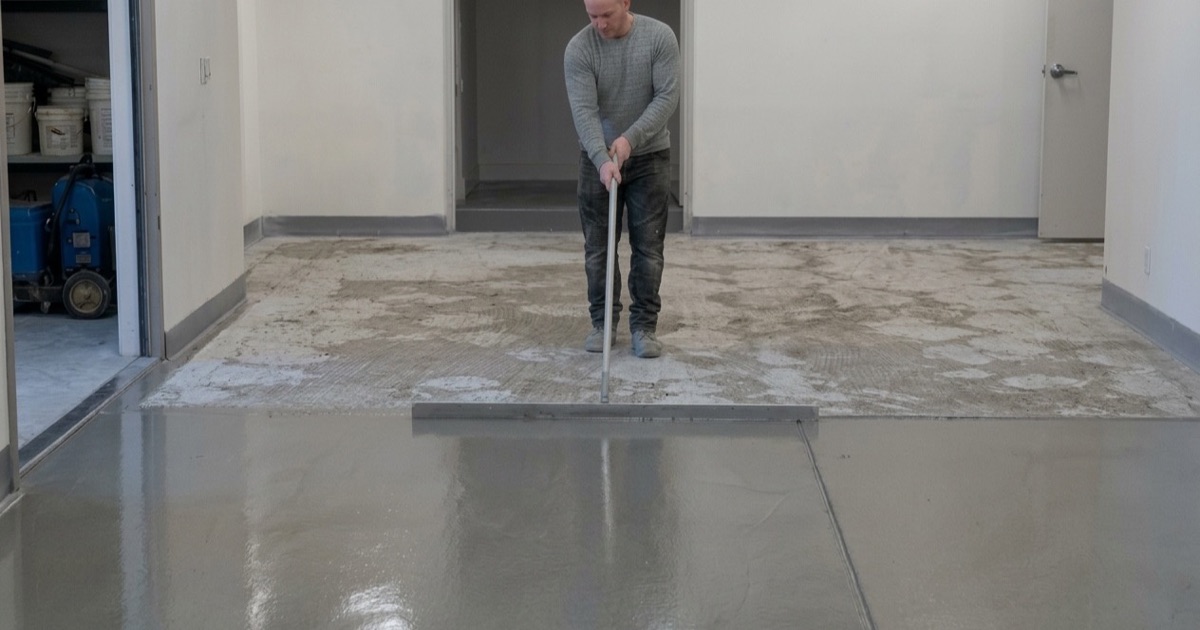
A polymer-modified overlay is a cement-based material with a polymer that gives it adhesion and flexural strength ordinary concrete does not have. It can be placed thin, bonds to a properly prepared slab, and takes a coating, a stain or a polish afterward. It is the workhorse for restoring a spalled or worn surface where the structure below is fine.
Self-Leveling Underlayments
Where the problem is plane rather than surface — a slab that dishes, slopes the wrong way or has been patched into unevenness — a self-leveling material finds its own level and produces a flat substrate. It needs an accurate primer and a contained perimeter, and it is unforgiving of a slab that has not been properly prepared. Used correctly it fixes a floor no amount of coating can flatten.
Microtoppings and Decorative Overlays
A microtopping is a very thin overlay used where the goal is appearance rather than repair, and it can be troweled, textured or colored before sealing. It restores a uniform surface over a slab with cosmetic damage. It carries less abrasion resistance than a full coating system, so we recommend it where the traffic actually suits it rather than everywhere.
Repair Mortars for Localized Damage
Not every slab needs a full overlay. Isolated spalls, broken edges, old anchor pockets and pipe penetrations are better handled with a repair mortar matched to the surrounding concrete, saw-cut square and keyed in rather than feathered. Feathered edges are the most common reason a patch fails, and a patch that fails takes the coating over it with it.
Resurfacing Over Ground That Moves
Detailing the Cracks Before Anything Is Placed
Every crack is assessed before an overlay goes down, and the working ones are treated as joints rather than filled solid. That means routing them out, filling with a semi-rigid polyurea and carrying the joint up through the new surface so it can keep moving. An overlay placed across a live crack will crack in the same line, and usually within a season here.
Honoring Existing Control Joints
Control joints exist to tell the slab where to crack, and burying them under a continuous overlay does not remove that need — the slab still moves and the joint still works. We carry every existing control joint through the new surface. A resurfaced floor with the joints paved over is the single most common way this work is done badly.
Moisture, Before and After
An overlay changes what is happening at the top of the slab but not what is coming up through it. Where a coating or a sealed finish is going over the new surface we test the slab first, with calcium chloride to ASTM F1869 or in-situ relative humidity probes to ASTM F2170. Placing an overlay over an untested slab and then sealing it can trap a vapor drive under a much more expensive floor.
Our Concrete Resurfacing Process
Assessment and an Honest Verdict
We sound the slab for delamination, look at the crack pattern, check for movement and moisture, and tell you whether this is a surface problem an overlay solves or a structural one it does not. Where it is structural we say so and stop, rather than selling a floor that will fail.
Removal and Preparation
Everything unsound comes off, mechanically, until only well-bonded concrete remains, and the surface is opened to the profile the overlay needs. Failed material left in place is the substrate the new floor will eventually fail from.
Priming, Placing and Detailing
The slab is primed to the manufacturer’s requirement, the overlay is placed to the specified thickness, and joints and working cracks are carried through as it goes rather than cut in afterward. Placement is scheduled against the slab temperature, because these materials have working times that shorten sharply in summer heat.
Finishing and Handover
The new surface is finished to whatever comes next — a texture, a coating, a stain or a polish — and we hand over with the cure schedule and the return-to-service date written down. Where a coating follows, we tell you what the overlay’s own cure adds to the timeline before you plan around it.
- 20+ Years Experience
- Insured & City Registered
- Free Estimates