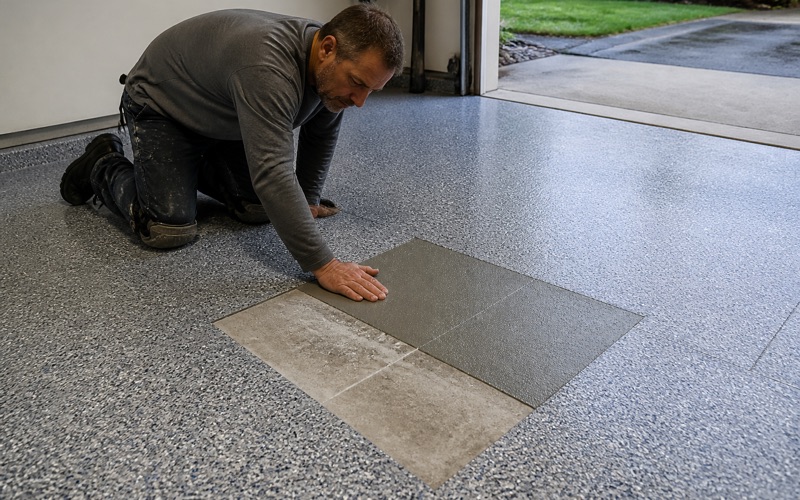
Killeen Epoxy Flooring has been quoting epoxy flooring in Copperas Cove for more than twenty years, and on a large share of the garages here the first day of work has nothing to do with installing anything. It has to do with removal. Most of the floors we are asked to look at in this city have already been coated once.
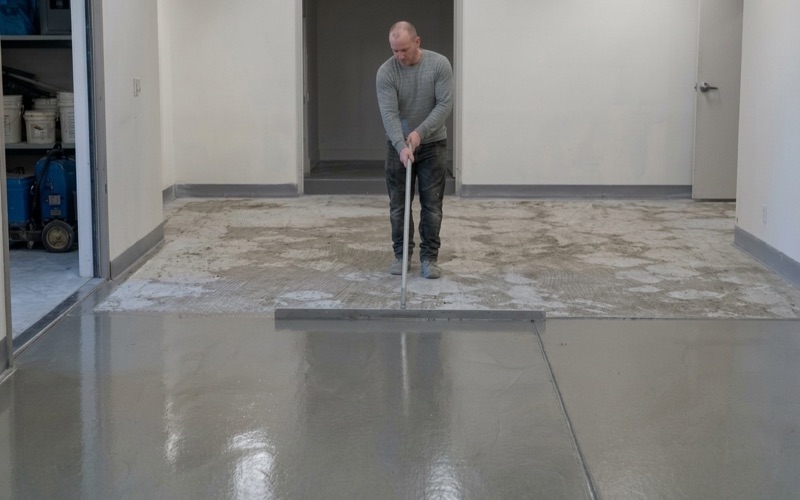
That changes the entire shape of an estimate. A bare slab is a known quantity; a slab carrying an unknown film from an unknown year is not, and the real cost of the job sits almost entirely in what it takes to open that surface back up. We price removal as its own line rather than folding it into a square-foot number and hoping it covers.
It also changes what we ask before we come out. We want to know what is on the floor now, roughly when it went down, and how it is failing: peeling, lifting under a tire, or clouding and chalking. Those three answers point at three different causes, and they change the system we end up recommending.
The most common garage in town, and what is already on its floor
A 1970s double bay is the modal address here
The 1970s is the single largest decade in this city’s housing stock at 3,448 units, a little over a fifth of everything standing, which makes the pre-1980 double-bay garage the most common substrate we work on. Those slabs have had five decades to collect motor oil, tracked-in grit, and whatever the last three owners decided to pour out in them.
Age on its own is not a problem. A well-placed 1970s slab is often flatter and denser than something poured in a hurry during a boom year. What age guarantees is history, and history on a garage floor means contamination that has soaked in rather than sat on top of the concrete.
The build curve is flat, so the address predicts nothing
The rest of the stock is spread almost evenly across the decades that followed: the 1990s at 16.8 percent, the 1980s at 16.5, the 2000s at 14.5 and the 2010s at 13.7. No single era dominates, so no standard bay width, no standard door opening and no standard driveway approach can be read off a street name here.
That is why we measure. In a subdivision built all at once the step is close to optional; here it is not, and a number given from a satellite image is a number that changes on the day. Measuring also tells us where a grinder can physically reach and how much edge work has to be done by hand.
Preparation, not product selection, is where the job is won
On recoat stock the product line matters far less than most people expect. Two contractors quoting the same 100% solids epoxy on the same floor get completely different results if one opens the slab to an ICRI CSP profile and the other scuffs it. Adhesion is a mechanical property of the surface underneath, not a claim on a data sheet.
So our proposal names the product, the system build and the finished mil thickness, and it describes the preparation as its own scope rather than burying it. You should be able to hold the quote against what actually went down on your floor and check the two against each other.
Looking for epoxy flooring closer to Belton? See Epoxy Flooring Services in Belton.
Taking an old coating off without wrecking the slab under it
PCD tooling first, then a finer diamond pass
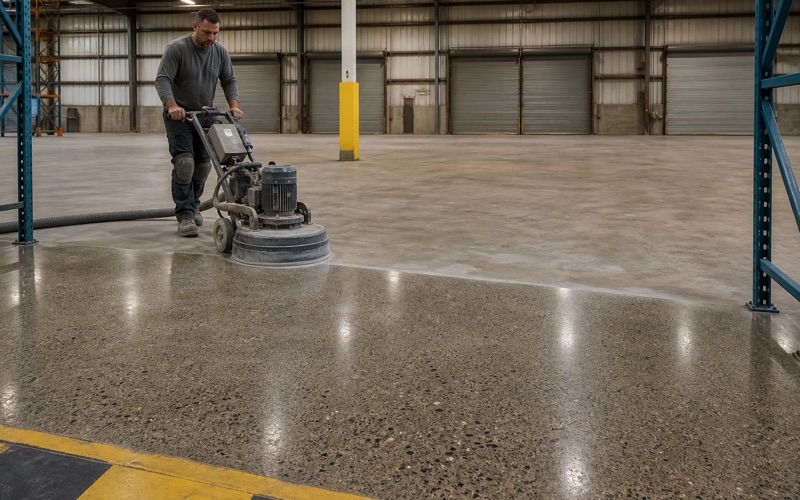
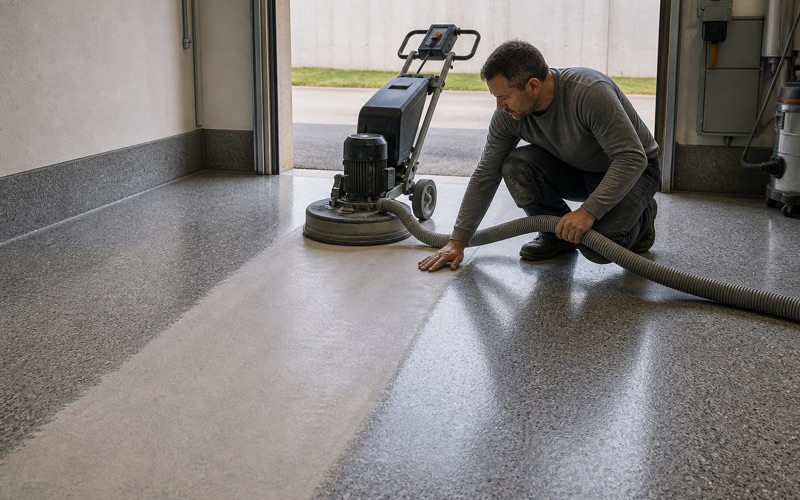
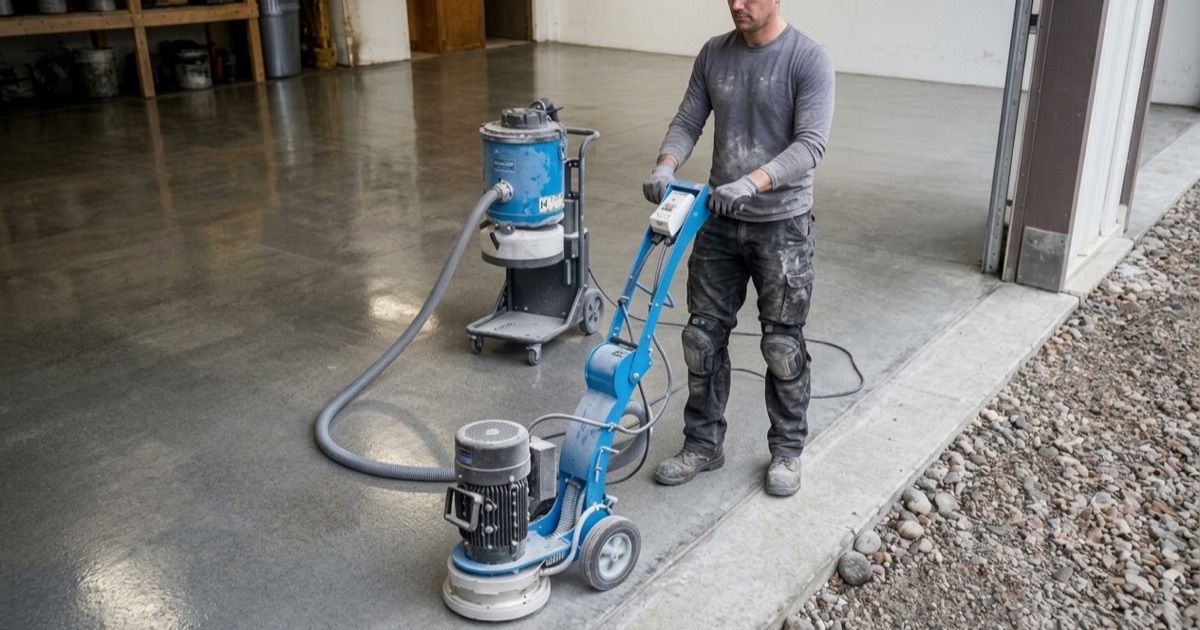
A cured coating does not come off a garage-sized floor with a chemical stripper in any economic way. We take it off mechanically, usually with PCD tooling on a grinder, which shears the film loose rather than trying to abrade through it. Shot blasting has its place on larger bare slabs and is the wrong first tool over a thick elastic film.
PCD leaves a coarse, torn surface, so it is never the last pass. A finer diamond segment follows to bring the concrete back to a consistent open profile, with segment bond hardness matched to how hard the slab is: soft bond on hard concrete, hard bond on soft. Reverse that and you either glaze the floor or eat it.
No acid etching, and never over an existing sealer
We do not acid etch. It produces an uneven bite, leaves salts behind that have to be neutralized and rinsed, and on a floor that has already carried a coating it cannot reach the part that matters. We also do not put a new system over an old sealer, whether or not that sealer still looks sound.
The second one is where a cheap quote usually hides its cost. Coating over a sealed slab produces a floor that looks finished for a season and then delaminates in sheets, taking the new material and the old one off together. Removal is the price either way; the only question is whether you pay it once or twice.
The failure pattern tells us what to specify next
What comes off tells a story worth reading. A film peeling cleanly in wide sheets with a chalky underside usually failed at the bond line, which points back at preparation. Rings lifting where the tires park are hot tire pickup, which points at a thin build or a chemistry that softens. Small domed blisters point at vapor coming up through the concrete.
Those three failures call for three different answers and only one of them is solved by a better topcoat. We would rather find the cause during removal than guess at it in a proposal, which is why a removal day occasionally changes the system we install.
Conventionally reinforced slabs from before the post-tension era
What predates 1980 sits on ground-supported concrete
Post-tension slabs became common in Texas after about 1980, and 35.8 percent of this city’s housing stock predates that line. On the 1970s stock the slab is conventionally reinforced ground-supported concrete, which makes anchoring, coring and saw cutting ordinary operations rather than a tendon risk.
The other 64.2 percent came afterward, and on those we establish slab type before anything is cut. A tendon is unforgiving and it is not visible from the surface. This is one of the few places in the trade where the year a house was built genuinely changes what a crew is allowed to do to the floor.
Ground here that mostly stays where it is
The soil under this city is the quiet outlier of the area. The map unit at the city centroid is Topsey clay loam on 3 to 8 percent slopes, a well-drained profile carrying 30 percent clay and a plasticity index of 18, with linear extensibility of 3.0 percent in the top 20 centimeters and 1.9 percent between 48 and 71 centimeters. That is a low shrink-swell rating.
It matters because of what it lets us say about a crack. On high-movement ground a crack is a joint that opens every dry summer and closes again, and no film stops it. Here the odds are much better that a given crack is shrinkage or settlement that has finished moving, which makes a permanent repair a defensible recommendation rather than wishful thinking.
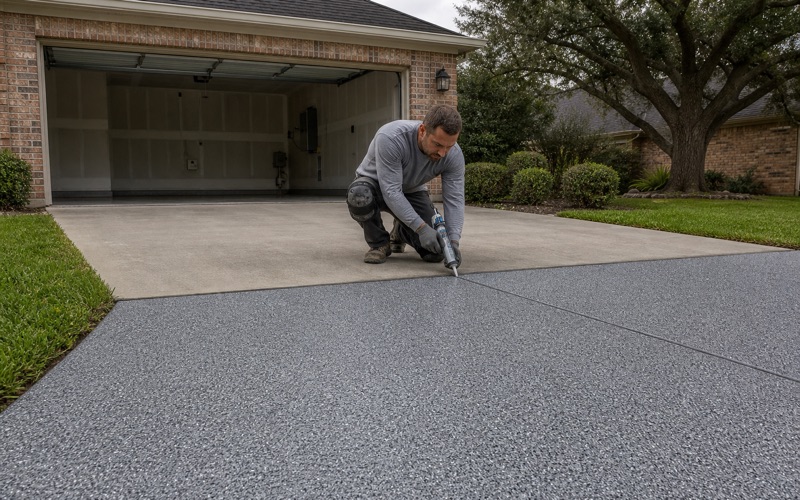
We still say plainly what a coating cannot do. It is a bonded film a few thousandths of an inch thick, it follows the slab underneath it, and nothing we install will stop or bridge ground movement. Where a crack is still working we route it, fill it with a semi-rigid polyurea joint filler, carry it through the finished floor as a joint, and tell you before the job that it can telegraph again.
Moisture testing goes in as a line item
Well-drained ground is not the same thing as a dry slab. Concrete poured on grade without an effective vapor retarder passes moisture regardless of how the surrounding soil drains, and vapor drive is the single most common reason a garage coating blisters. On an older slab, testing goes into the scope as a line item rather than being sold as an extra after a floor has already failed.
Which test depends on the floor. ASTM F1869 calcium chloride measures the moisture vapor emission rate at the surface, ASTM F2170 relative humidity probes read what is happening inside the slab, and ASTM D4263 is a fast plastic sheet screen. We read all of them against the ASTM F710 thresholds, and where a slab is over them we price a moisture-mitigation primer instead of hoping.
Households arriving from out of state and leaving on the same orders
A calendar that belongs to somebody else
This city takes in more out-of-state arrivals as a share of its population than the places around it. In a single year 3,235 people, 8.6 percent of the population, moved here from a different state, and 21.9 percent of everyone aged one and over lived somewhere else a year earlier. Armed Forces members are 12.6 percent of the labor force.
The practical effect is that dates are not negotiable. Households arrive on orders and leave on orders, and a floor that is not walkable and drivable when the truck shows up is a failure no matter how well it was installed. We quote a return-to-service honestly and pick the system that fits the date rather than the one that reads best on paper.
Rental turnovers on a short cycle
Renters are 40.3 percent of households here, and 2,337 single-family detached houses are rented out, roughly one in five occupied detached houses in the city. On that stock a garage floor is a turnover decision, bought for how it survives a move-out and how quickly it can be handed over, not for how it photographs.
The cycle is measurably short. 52.6 percent of renter households moved into their current unit in 2020 or later, against 24.5 percent of owner households. For a landlord that makes cure time a commercial constraint rather than a technical footnote, so we say up front which build gets a floor back into service inside a vacancy window and which one does not.
What we can show you, and what needs a different permit
Texas licenses no flooring contractor, so there is no license number to quote and anyone offering one is describing something else. What we can put in front of you is our City of Killeen general construction registration, general liability cover, workers’ compensation and a Texas sales and use tax permit. A residential job here runs through the City of Copperas Cove Building Department, which sits inside Development Services and takes permits through an online portal.
The city has adopted the 2024 ICC family including the 2024 International Residential Code, so this is a current code cycle rather than the older edition a contractor might assume. And if a slab needs structural repair before it can be coated we say so plainly: foundation work here carries its own permit, which a floor coating does not, and we would rather lose the job than coat over the problem.
- 20+ Years Experience
- Insured & City Registered
- Free Estimates