
Killeen Epoxy Flooring has installed flake epoxy floors across Killeen, TX for more than 20 years, serving surrounding cities including Fort Hood, Harker Heights, Nolanville, Copperas Cove and Belton. A flake epoxy floor is a system rather than a single product: colored vinyl chips are broadcast into a wet resin base, the loose material is scraped back the next day, and a clear topcoat locks the surface down.
That makes this a selection job more than a shopping job. Chip size, blend, coverage and topcoat sheen move independently of each other, and two floors poured from the same pail of resin can look nothing alike depending on how those four are set.
What gets settled before any of it is the slab. The ground here is San Saba clay, a smectitic Vertisol running near 50 percent clay with a plasticity index of 40 and a linear extensibility around 10 percent, which is a very high shrink-swell rating. Slabs on it move with the season, so we find out what yours is sitting on before we quote, and the crack detail is written into the proposal ahead of any color.
Chip Size Sets the Character of the Floor
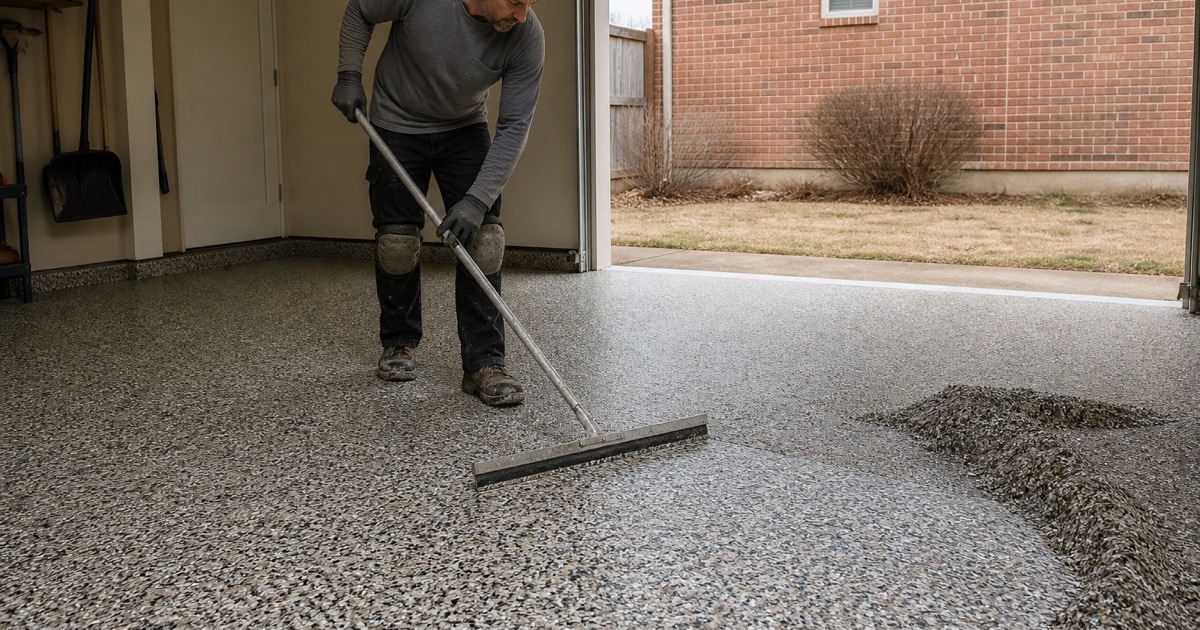
Vinyl flake is sold by nominal chip width, and that width does more to the finished look than the color does. A one-sixteenth-inch micro chip reads almost as a solid field with a fine speckle in it, which suits a small utility room or a laundry where a busy floor would crowd the space.
Quarter-Inch Chip, the Residential Standard
Quarter-inch is what most home garages around Killeen get, and there is a reason beyond habit. At that size a single chip is visible from standing height without any one of them drawing the eye, so the floor reads as texture rather than as pattern. It also covers more square footage per pound than the larger sizes, which matters across a two-car bay.
Half-Inch and Larger Format
Half-inch and one-inch chips read as deliberate flecking and need distance to work, so they belong in a long shop bay, a showroom or an open basement. In a 400-square-foot garage the same chip can look scattered rather than designed. Large format also lands less densely per pound, so the base coat underneath has to be the right color.
Reading a Blend at Floor Scale
A blend is a pre-mixed proportion of two to five chip colors, usually with one dominant color carrying 50 to 70 percent of the mix. Those proportions are what you are actually choosing, and they are more decisive than the individual colors look on a chart.
A Sample in the Hand Lies About Scale
A three-inch sample card shows a chip density no finished floor ever has, because your eye takes in every chip at once. We bring samples sized to be laid on the floor and looked at from standing height, under the light the room actually has. Garage lighting pulls a blend colder than a showroom does, and a mix chosen under shop tubes can read flat gray in a bay lit through an open door.
The Base Color Underneath
The base coat shows through everywhere the chips do not sit edge to edge, and on a partial broadcast that is most of the floor. A black base under a gray-and-white blend gives depth and swallows tire marks; a light base under the same blend reads open and shows dust sooner. We pick the base with the blend, never after it.
Broadcast to Refusal, or a Partial Scatter
Broadcast to refusal means chip is thrown into the wet base until the surface will not take any more and the excess bounces off. The result is close to 100 percent chip coverage with the base color invisible, and it is the more durable of the two options, because the scraped and sealed chip layer adds real thickness to the system.
A partial broadcast, anywhere from 20 to 60 percent coverage, leaves the base color as part of the design. It costs less in both material and labor, and in a room where that base color is the point it is the better looking choice. What it does not do is add the same build, so we specify the clear coats differently when the broadcast is partial.
Coverage is a number that belongs in writing. Our proposals name the product, the system build and the finished mil thickness, so what you were quoted can be checked against what actually went down.
What Flake Hides, and What It Will Not
Flake is genuinely forgiving of a slab’s cosmetic history. Trowel burnish marks, small divots, patch shadows and the color difference where an old adhesive was ground off all disappear under a full broadcast, which is why flake outperforms a solid color on a slab that has already had a working life. In service it also hides dust, hairline tire scuffing and the traffic pattern that shows on a plain gray floor inside a season.
What it will not do is hide movement. A coating is a bonded film a few thousandths of an inch thick and it follows the concrete underneath it exactly, so nothing we install stops or bridges seasonal ground movement. A crack that is still working gets routed out, filled with a semi-rigid polyurea joint filler and carried through the coating as a joint rather than buried under it, and you are told before the job that it can telegraph again.
Scraping, Sealing and the Finished Texture
The day after the broadcast the floor is scraped and vacuumed to knock down every chip standing on edge, then sealed. That scrape is the difference between a floor that feels like fine sandpaper and one that feels like a floor, and it is the step most often cut short.
Sealing is where texture is set. A clear grout coat of 100% solids epoxy fills between the chips and levels the surface, and a polyaspartic or polyurea topcoat over it sets the sheen and the return-to-service window. Two clear coats give a smoother, more washable floor than one, while a fine aggregate broadcast into the last coat raises the coefficient of friction for a slope or a wet entry at some cost in cleanability.
Preparation under all of it is mechanical. We open the slab with a grinder or a shot blaster to an ICRI CSP 1-10 profile, we do not acid etch, and we do not put a new coating over an old sealer. Flake bonded to a sealed slab looks correct for about a year and then lifts in sheets.
- 20+ Years Experience
- Insured & City Registered
- Free Estimates