Killeen Epoxy Flooring has been installing epoxy flooring in Harker Heights for more than twenty years, and the first question we settle on a quote here is not the color. It is how long the person buying the floor expects to be standing on it. That answer moves the system build, the topcoat and the warranty conversation further than any product preference does.
Our proposals name the product, the system build and the finished mil thickness, so what you were quoted can be checked against what actually went down on the concrete. We put the limits in the same document. A coating is a bonded film a few thousandths of an inch thick, it follows the slab underneath it, and nothing we install will hold still while the ground beneath it does not.
Texas licenses no flooring contractor, so there is no license number for us to quote and none for anyone else in this trade to quote either. What we show instead is a City of Killeen general construction registration, general liability cover, workers’ compensation and a Texas sales and use tax permit. Ask any coatings company here for those four and read what comes back.
A city where people stay, and what that changes about the sale
The owners are the majority, and the numbers are not close
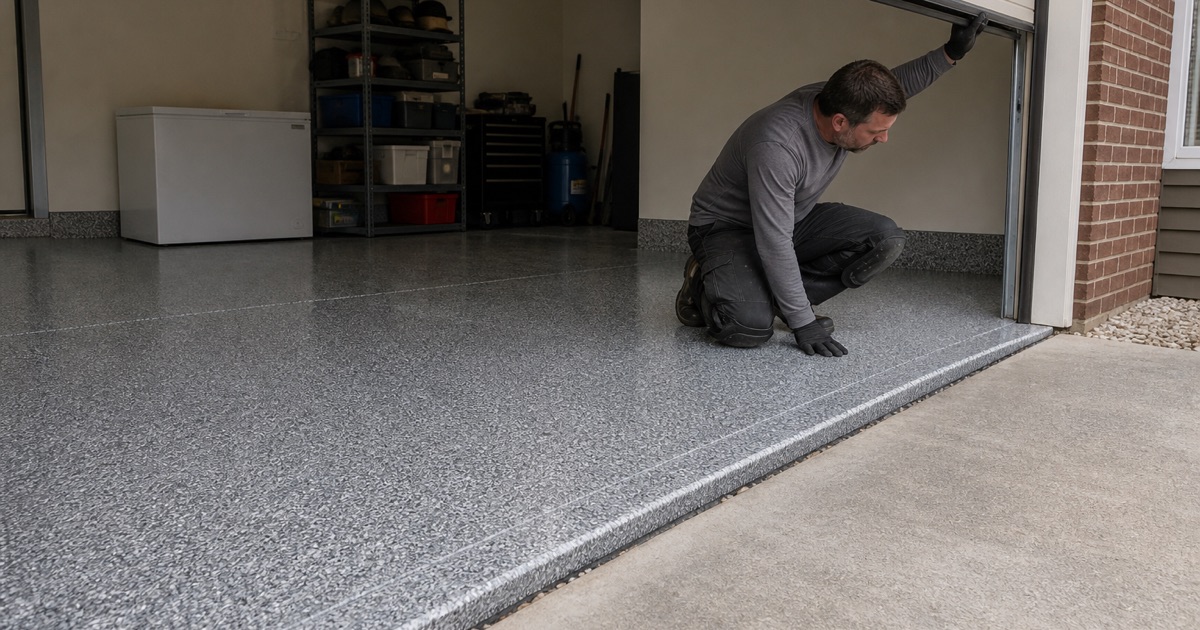
This is a 61.7 percent owner-occupied city, with 7,699 owner households against 4,770 renter households out of 12,469 occupied units. Only 14.5 percent of the population lived somewhere else a year ago. Those two figures together describe a settled community, and a settled community buys a garage floor on a different clock.
Armed Forces members make up 10.9 percent of the labor force and the city functions largely as a bedroom community for work elsewhere in the county. A residential job at an address inside the city limits runs through the municipal building department and needs no gate pass, no vetting and no truck inspection. We do not bill for access we did not have to arrange.
An improvement, not a turnover item
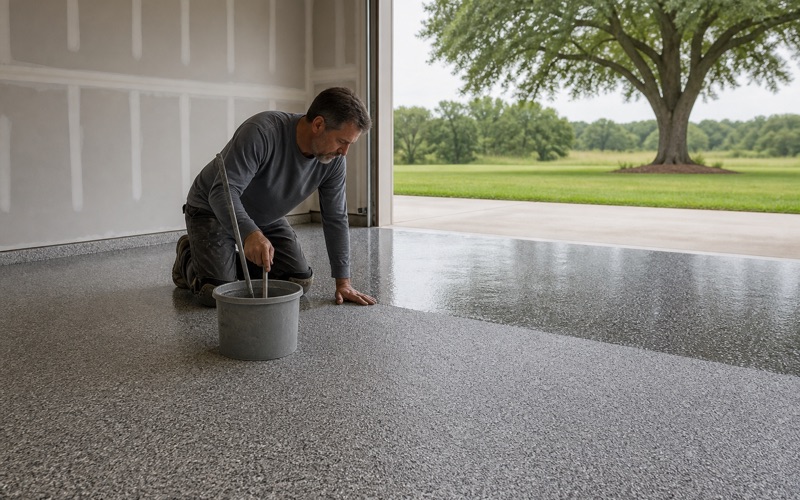
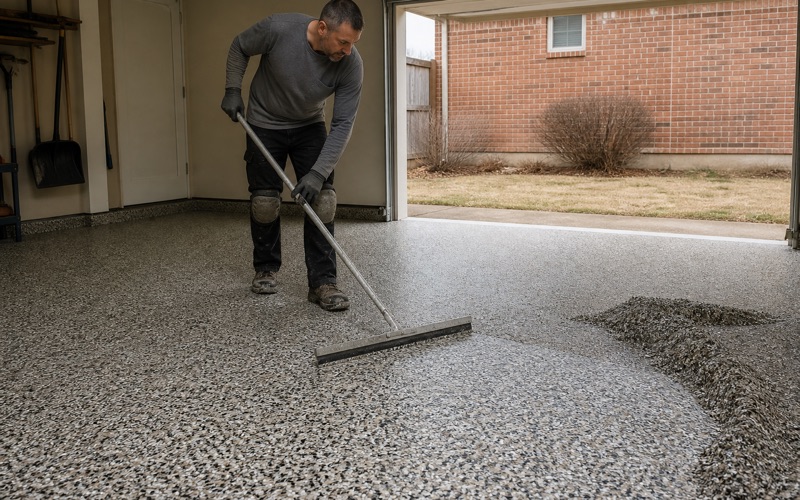
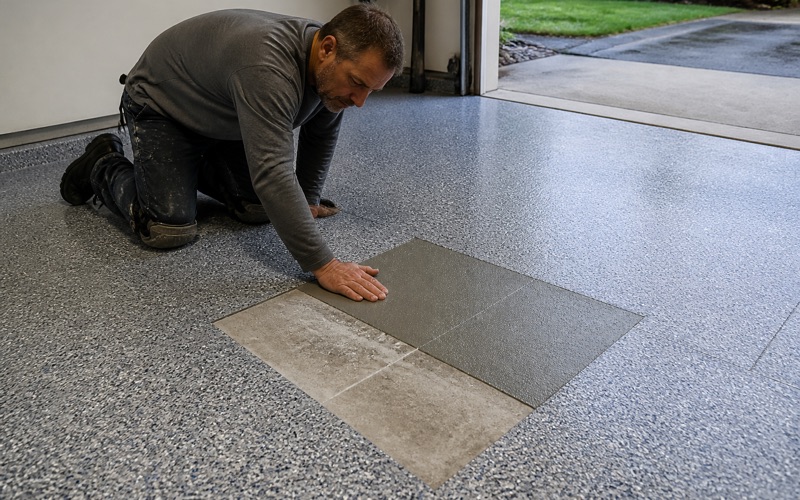
Most of the garage work we do here is an appearance-led purchase. The customer is picking a vinyl flake blend or a quartz aggregate broadcast, choosing a gloss level, and thinking about a surface they will look at every day for years. That conversation is about chip size, color and how the finished floor reads under a garage light.
It also means the durable choices are worth explaining rather than assuming. A hundred percent solids epoxy body coat under a polyaspartic topcoat costs more than a thin roll-on kit and lasts on a completely different scale. Over a ten-year horizon the arithmetic is not close, and we would rather show it than quietly sell around it.
The rented houses, and the households with no slab at all
There is a genuine rental segment here and dismissing it would be wrong. Some 1,532 single-family detached houses in this city are rented out, and 48.4 percent of renter households moved into their current unit in 2020 or later. On those addresses a floor is a durability decision with a date attached to it, so the return-to-service window is part of the deliverable and we quote it honestly.
The other correction worth making is that 884 occupied mobile homes stand here, 7.1 percent of occupied units, split 545 owner-occupied and 339 renter-occupied. Almost none of them come with a garage slab. The household total therefore overstates the addressable market for this trade, which is one reason we ask before we pitch.
Looking for epoxy flooring closer to Nolanville? See Nolanville Epoxy Flooring.
Choosing a floor you expect to be standing on in ten years
Cracks are treated as joints that are still working
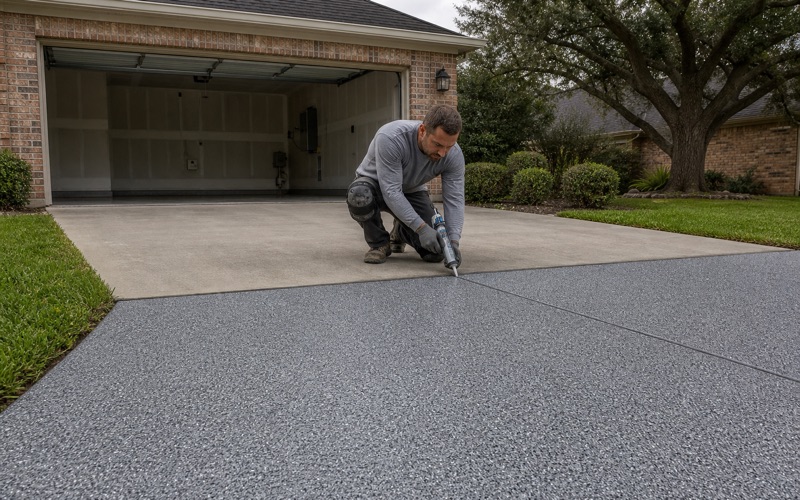
Where a crack runs through a slab over ground that still moves, we route it and fill it with a semi-rigid polyurea joint filler, then carry it through the coating as a joint. We do not fill it hard, coat over the top and hope. You are told before the job that a working crack can telegraph again.
The alternative fails in a predictable way and we have been called out to look at it. A rigid fill over a live crack does not stop the movement underneath; it decides where the next failure shows up, usually as a ragged line through a finish that was perfect a season earlier. Naming that risk in advance is cheaper for everyone involved.
Moisture testing is a line item, not a surprise
On an older slab, moisture testing goes into the scope as a priced line before the work is sold. Calcium chloride testing to ASTM F1869 and in-situ relative humidity probes to ASTM F2170 produce a number, and ASTM F710 supplies the threshold that number has to clear. A plastic sheet test to ASTM D4263 is a screening check rather than a substitute for either.
Where the readings come back high, the answer is a moisture-mitigation primer written into the proposal with its own price against it. What we will not do is sell a floor, watch it blister, and then present the mitigation afterward as an extra. That sequence is one of the most common ways a residential coating goes wrong in this part of Texas.
Preparation is mechanical, every time
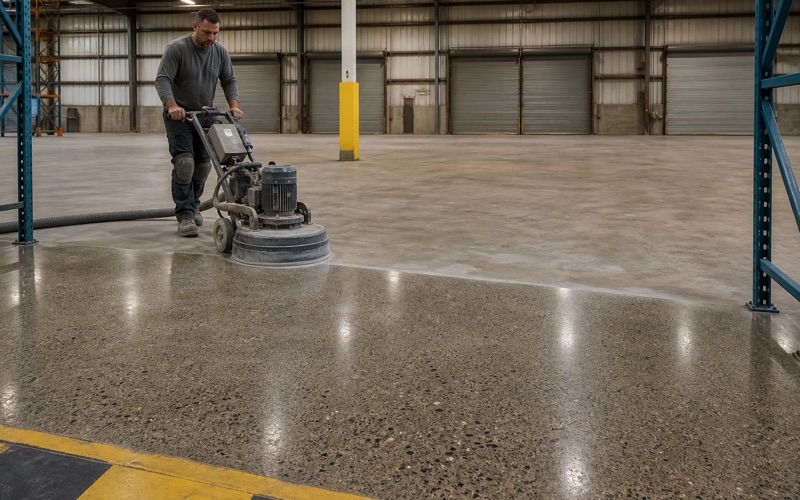
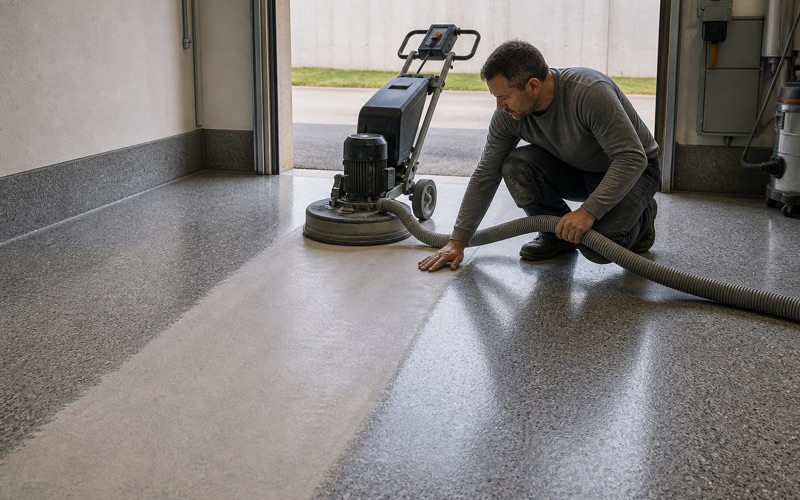
Every slab we coat is opened mechanically with a diamond grinder or a shot blaster to an ICRI CSP profile appropriate to the system going down. We do not acid etch. Where an old coating or sealer is present it comes off first with PCD tooling, because a new build over somebody else’s failing film inherits that film’s bond.
Diamond segment bond hardness gets matched to the concrete rather than to whatever happens to be on the machine, since a hard slab and a soft slab do not profile the same way at all. This is the unglamorous half of the work and it is the half that decides whether the finish is still stuck down in year eight.
Why this trade has no historic-property side in this city
A community that starts in 1957
Pinckney R. Cox and Harley Kern began subdividing and selling lots here in 1957, and the community incorporated on September 24, 1960, taking its name in honor of Kern. That start date is written straight into the housing stock: exactly one unit dates to the 1940s and none at all predates 1940.
So the pre-war repertoire this trade carries in older markets simply has nothing to attach to. There are no 1920s slabs breaking up under a coating, no converted outbuildings with mystery floors, no pre-code garage bays. Nobody here needs to be sold a heritage-substrate assessment for concrete that did not exist before the late 1950s.
Where the older end of the stock actually sits
The oldest working layer is the 1970s, at 17.9 percent of units and 2,359 homes, with 20.8 percent of all stock built before 1980. Those are the addresses where a single attached bay or a carport conversion turns up instead of the modern two-car front-facing box.
A 1970s slab in this city is likely conventionally reinforced and ground-supported, poured before under-slab vapor retarders were routine practice. That is a real reason to test moisture rather than assume it, and it is the strongest argument for putting ASTM F1869 in the scope on the older half of the market.
The newer majority, and what it hides
Some 53.4 percent of housing units here were built in 2000 or later and 26.5 percent in 2010 or later, the 2000s being the single largest decade at 3,548 units. Newer concrete is generally flatter and easier to profile, which leads people to assume it is simpler to coat.
It is not automatically simpler. Post-tension slabs became common in Texas after about 1980 and 79.2 percent of this stock postdates that line, so cutting, coring or driving an anchor without knowing where the tendons run is a live risk at most modern addresses. We establish slab type before anything penetrates the concrete.
Garage slabs on ground that is partly rock
Nineteen inches of soil, then limestone
The soil survey at the city centroid maps the Speck association on 1 to 8 percent slopes, Speck at 82 percent of the map unit, a clayey Lithic Argiustoll, well drained, carrying an indurated bedrock restriction at 48 centimeters. That is roughly 19 inches of soil sitting on solid rock.
This is close to the opposite of what the surrounding region’s reputation would lead a contractor to assume. There is far less material available to swell and shrink than a deep clay profile offers, so the seasonal movement available to a slab here is moderate rather than severe. Moderate is not zero, and the crack detail follows from that.
Two layers that do not move together
The profile that does exist is still clayey, and it is not uniform from top to bottom. From the surface to 20 centimeters it runs 29.5 percent clay with a plasticity index of 23 and linear extensibility of 4.5 percent. From 20 to 48 centimeters it runs 47.5 percent clay, plasticity index 33 and linear extensibility 7.5 percent.
The upper layer and the layer beneath it therefore respond to a wet season at different rates. That difference is why we read the profile before quoting a crack detail rather than after, and why we will not describe your slab as evenly supported when the survey plainly says it is not.
One footprint, two kinds of support
On ground sloping 1 to 8 percent over a shallow bedrock contact, a single garage slab can bear partly on rock and partly on clay inside its own footprint. Differential support of that kind produces cracking that is not uniform across the floor, which is exactly the pattern we get called out to look at.
That is why we find out what your slab is sitting on before we quote it rather than pricing from a photograph and a square footage. A specification written for an evenly supported floor does not describe this ground, and a proposal that ignores the difference is quoting a different garage than the one you own.
- 20+ Years Experience
- Insured & City Registered
- Free Estimates