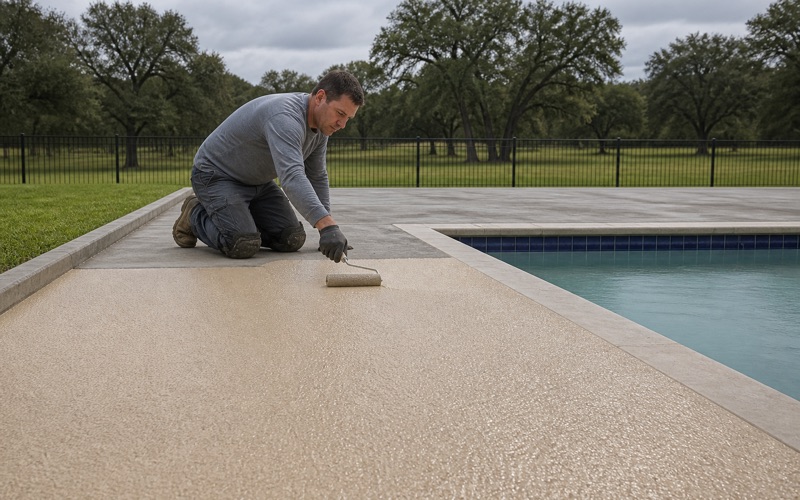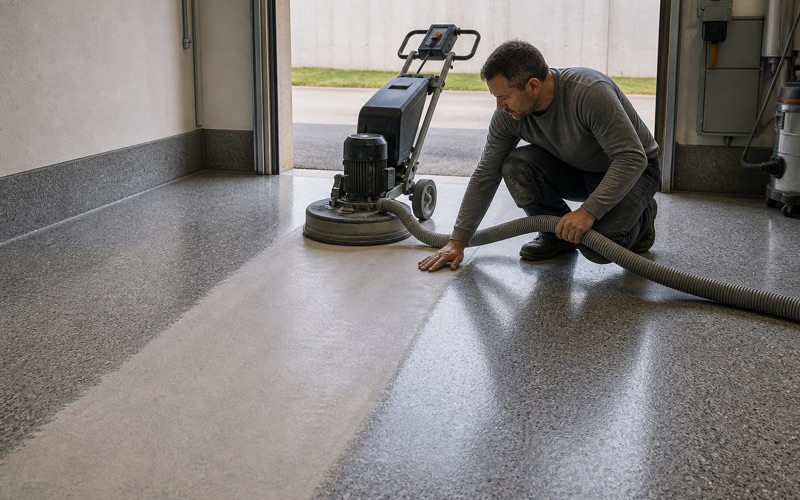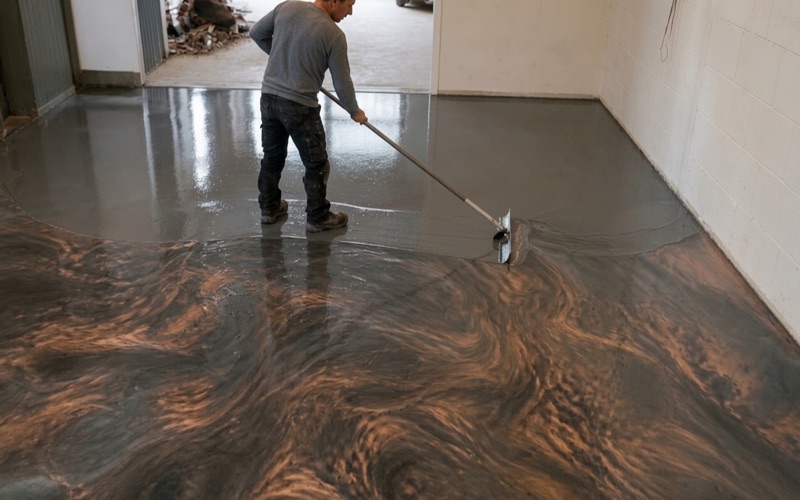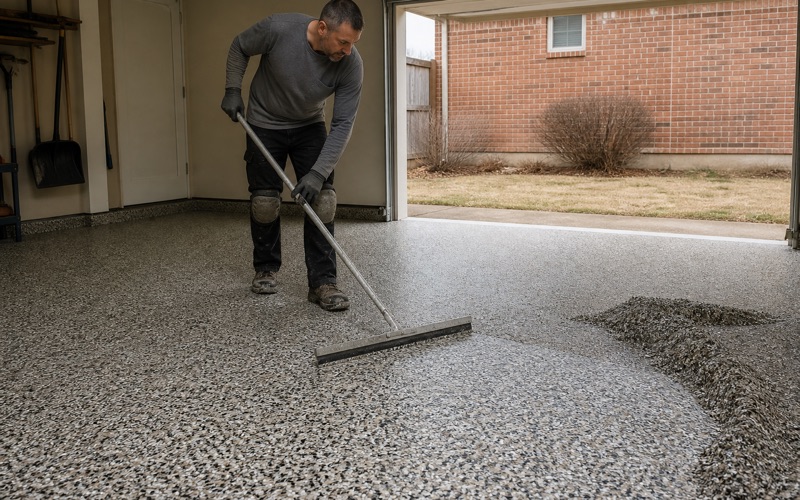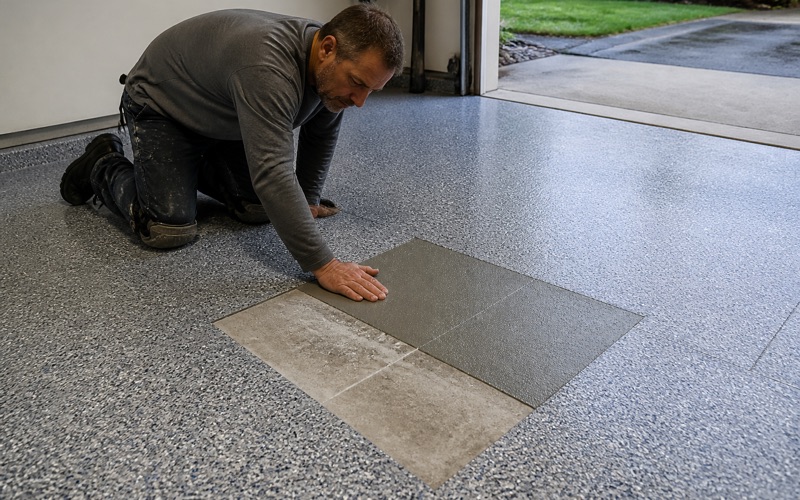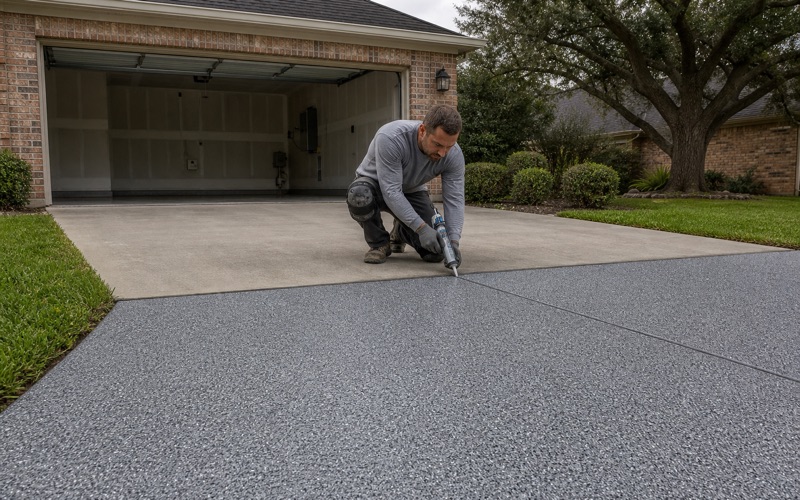
Killeen Epoxy Flooring puts more epoxy flooring in Lampasas into barns, shops and outbuildings than into attached house garages, and after twenty years working this trade area that is not a surprise. It is what the county in front of us looks like.
The buildings behind that demand sit mostly on small acreage. There are 1,076 farms in this county, 386 of them between 10 and 49 acres and 526 of them selling under $2,500 a year — a landscape of small tracts funded largely from off-farm income, each one typically carrying a single metal barn or shop building on a slab.
The other thing that shapes a quote here is that the ground under this city is not one thing, and it is emphatically not what the regional story says it is. Roughly 60 percent of the land inside the city limits is soil that stops at rock within a foot and a half of the surface. About 20 percent carries movement as high as anything in Central Texas. Which of those you are on depends on your elevation.
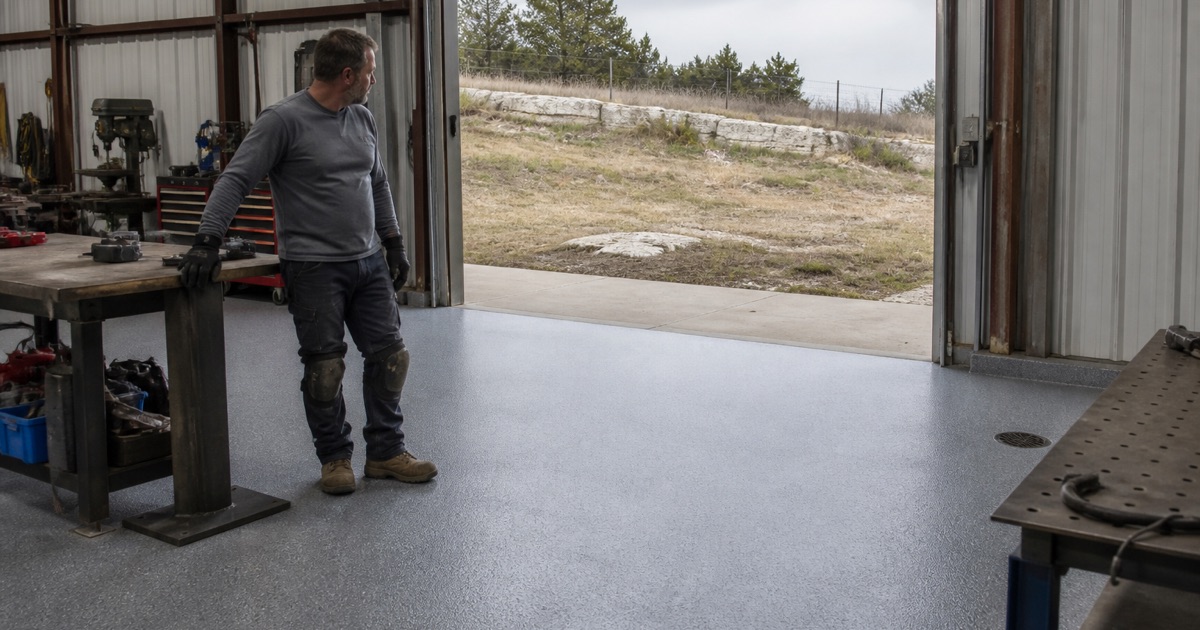
Shop and barn floors on small acreage, and what they are asked to survive
The floors themselves
Agriculture in this county is 95 percent livestock by value of products sold, and two categories punch far above the county’s size: sheep, goats, wool and mohair rank 23rd of 254 Texas counties, and horses rank 43rd. Equine and small-livestock property means barn aisles, wash racks, tack rooms and trailer bays.
Those are wet, chemically loaded, cleanability-driven floors rather than appearance upgrades. A wash rack takes standing water, hoof traffic, disinfectant and manure, while a tack room takes leather conditioner and constant foot traffic.
A trailer bay is different again, taking hot tire pickup and dropped steel. They are not one specification, and quoting them as one is how a floor fails in the wettest room first.
The buyer is a household, not a capital budget
Net cash farm income for this county is negative, and roughly three quarters of its farms sell under $10,000 a year. The person paying for a shop floor here is nearly always making a discretionary household decision about an outbuilding rather than drawing on an operating budget.
That changes how we write a proposal. It names the product, the system build and the finished mil thickness, so what you were quoted can be checked against what actually went down, and where a cheaper build genuinely suits the use we say so instead of selling up. A wash rack earns urethane cement and an integral coved base. A hay-side storage bay very often does not.
A metal building slab is its own problem
An unconditioned metal building slab is usually a single monolithic pour with saw-cut control joints, no climate control above it and, on older construction, no vapor retarder beneath it. It takes ground moisture from below, condensation from above, and a seasonal temperature swing a conditioned garage never sees.
So a moisture test belongs in the scope on any slab of uncertain age out here: calcium chloride to ASTM F1869 or in-situ relative humidity probes to ASTM F2170, read against ASTM F710, with a plastic sheet test to ASTM D4263 as the cheap first look. Skipping it is how a floor blisters six months after it looked perfect.
Looking for garage floor coating closer to Georgetown? See Garage Floor Coating Services in Georgetown.
Ground that changes with the elevation
Shallow soil over limestone on the uplands
About 60 percent of the land inside the city limits carries a bedrock or cemented-caliche restriction within 46 centimeters of the surface. Brackett covers 29.8 percent of the city with paralithic bedrock at 43 centimeters. The Lampasas series covers 18.2 percent with lithic bedrock at 28 centimeters, about eleven inches. Real covers 6.9 percent with a petrocalcic hardpan at 30 centimeters.
Those soils barely move. Brackett returns linear extensibility of 1.5 percent in both horizons above the rock contact, and Real 1.5 to 3.1 percent, which is low ground movement by any standard reading. The seasonal movement story that dominates coating work on reactive clay is largely absent on that side of town.
Deep clay on the valley floor, inside the same city limits
About 20 percent of the city carries the opposite condition. Krum silty clay, 9.1 percent of the area, is a fine smectitic Pachic Udertic Haplustoll formed in clayey alluvium from chalk and marl, running 45 to 50 percent clay, plasticity index 30 to 35, and linear extensibility of 9.7 percent through the top 20 centimeters.
Rumley, 10.8 percent of the area and the map unit at the city centroid, carries 7.5 percent linear extensibility through its upper 81 centimeters at 34 to 35 percent clay. Both are high to very high movement. A slab on either sits on ground that genuinely swells and shrinks with the year.
Which side of town you are on decides the crack detail
The split maps onto topography, because the map units divide by landform in their own series descriptions. The shallow soils sit on uplands and dissected-plateau backslopes; the deep clay soils sit on stream terraces and the valley floor at 0 to 1 percent slopes. The town is on Sulphur Creek at 1,030 feet with rising ground around it, so the practical reading is that the low ground carries the movement and the higher ground carries thin soil over rock.
A coating is a film a few thousandths of an inch thick. It follows the slab and it cannot bridge or resist movement, so on the valley soils a crack is a live joint — routed, filled with a semi-rigid polyurea joint filler and carried through as a joint, with the warning given first that it can telegraph again. On the upland soils the same crack is far more likely to be shrinkage or settlement that has finished. Treating them identically is the failure here, and pulling a soil map before quoting is a checkable step rather than a rhetorical one.
A soil series named for this county
What the Lampasas series actually is
There is a soil series named Lampasas and its type location is in this county. Its Official Series Description opens: “The Lampasas series consists of soils shallow to fragmental limestone. These are well drained, moderately slowly permeable soils on uplands.”
The numbers behind that description are specific. Solum thickness runs 9 to 20 inches, the fine-earth fraction is 35 to 45 percent clay, and coarse fragments make up 35 to 80 percent of the solum. In the typical pedon the limestone bed begins at 13 inches and is described as interlocking fragmental limestone, fractured at roughly one to four inch intervals. Eighteen percent of this city sits on it.
What rock at eleven inches means for the work
Rock fragment volume runs 26 percent in the Brackett surface horizon, 32 to 48 percent through the Lampasas horizons and 30 to 65 percent in Real. That is what a trencher, a core bit or a saw meets once it is through the concrete.
So on the upland side of town anything below the floor is a rock job rather than a dirt job — a drain line, a footing under a new load, a dowelled transition into an addition. It belongs in the price and in the schedule before the work starts, and it is the reverse of the assumption most Central Texas pricing carries.
Why the regional clay story does not apply here
Every major component of every map unit covering this city is an Inceptisol, a Mollisol or an Alfisol. Not one taxonomic order returned is Vertisols. No Heiden and no comparable deep smectitic prairie-clay series appears anywhere inside these city limits.
We state that because it is the single most common thing a page about Central Texas concrete gets wrong, and because it changes the recommendation rather than just the wording. A contractor reciting the regional expansive-clay story here is pricing a crack detail for movement that is simply not happening under a great deal of this town.
The slabs this town actually has, and who reviews the work
Two thirds of the stock predates the post-tension era
Lampasas has 3,297 housing units and 63.6 percent of them were built before 1980, with 38.6 percent before 1960 and the 1950s the single largest decade at 21.3 percent. Only 17.7 percent dates to 2000 or later.
Post-tension slabs became common in Texas after about 1980, which puts most residential and shop slabs in this town on conventionally reinforced, ground-supported concrete. On the newer minority the pre-step is different — a post-tension slab cannot be cored, drilled or saw-cut until the tendons are located — and we establish which one we are standing on before any blade goes down.
A real homeowner market, with a rented block behind it
Single-family detached units are 81.2 percent of the stock, and 1,799 of them are owner-occupied, which is 62.6 percent of all occupied units. Owner-occupied multifamily is effectively nothing. The addressable garage pool here is close to the whole owner-occupied stock rather than a slice of it.
There is also a real rented-house block of 513 renter-occupied detached units, where the work is authorized by a landlord rather than the occupant. On a rental turnover the date is part of the deliverable, so we quote the return-to-service honestly and pick the system that fits the lease rather than the one that reads best on paper.
Plan review, power, and what we do not assume
Effective March 2025, Bureau Veritas conducts all plan review, inspections and various other services for the City of Lampasas. Plan review here is a third-party contract rather than a city desk, which is worth knowing before anyone quotes you a review timeline. The adopted codes are the 2021 International Building Code, the 2021 International Residential Code and the 2021 International Energy Conservation Code with the 2020 National Electrical Code, and there is a staffed fire marshal for a solvent, ventilation or hot-work question.
The city is also its own electric utility, with an Electric Department and an Electric Superintendent, so a service upgrade or temporary power for grinding and extraction equipment on a shop job is one municipal call rather than a retailer plus a transmission utility. Whether contractor registration is required, and whether an interior floor coating triggers a permit at all, is not published — so we ask rather than assume a default. Texas licenses no flooring contractor, so there is no license number to show you either; what we can show is general liability cover, workers’ compensation and a Texas sales and use tax permit.
- 20+ Years Experience
- Insured & City Registered
- Free Estimates