Killeen Epoxy Flooring puts down epoxy flooring in McGregor the way we have done it across Central Texas for more than twenty years, which means the job begins with two questions rather than one: what is the slab sitting on, and how are we going to reach it. Both get answered before a number goes on a page.
Access is a bigger factor in this town than it is in most places on our list, and so is establishing who the local authority actually is. Both of those govern the schedule, and on a coating job the schedule is usually what decides whether the work goes well.
The paperwork behind the quote does not change from town to town. Every proposal names the product, the system build and the finished mil thickness, so what you were quoted can be checked against what went down, and the warranty exclusions are read out before anything is sold rather than found later.
Two counties, one city, and one permit counter
Which county line a job falls on
McGregor sits primarily in McLennan County, but the city limit extends westward into Coryell County, and that western extension is what wraps around McGregor Industrial Park. A residential address in town and an address at the park can sit in two different counties while both pull the same city permit.
That is a live distinction for anything running through a county office rather than a municipal one, and it is worth settling at the estimate instead of discovering on the morning of the job. For most floor work the city is the authority either way, but which county an address falls in is not something to guess at.
A permit path made of named people
The city’s Community Development department handles planning, zoning and building permits together, and the permit forms download straight from the municipal site. In a city this size a plan review is a phone call to a person rather than a ticket in a queue.
We would rather use that than work around it. Establishing early what the city treats as reviewable on a given job saves more time than any amount of chasing at the back end, and it means an inspection date is something a cure window can be planned around.
What needs a permit and what does not
A coating over sound concrete is a finish rather than a structural alteration, and it does not carry the permit burden that structural work does. We do not bill for access or administration we did not actually need.
If a slab needs genuine structural repair before anything can be coated, we say so and we stop there. Foundation work takes its own permit and its own inspection route, and it is not something to fold quietly into a flooring quote.
Looking for epoxy flooring closer to Fort Hood? See Epoxy Flooring in Fort Hood.
A volunteer fire department, and how solvent work gets scheduled
Who the fire authority is here
The fire authority in this city is the McGregor Volunteer Fire Department, listed among city services on the municipal site. The city’s own economic development director serves on it as a certified firefighter and training officer, which tells you something accurate about the scale of the organization.
That is not a criticism of the department. It is a fact about response capacity, and a contractor bringing solvent, resin and powered abrasives into an enclosed building here ought to know it before the truck is loaded rather than afterward.
Solvent load, ventilation and ignition sources
So the solvent-heavy end of the work gets planned around it. That means favoring 100 percent solids epoxy wherever the specification allows, since it carries far less solvent than older high-VOC systems, and keeping the volume on site down to what the day’s work will actually consume.
It also means ventilation and ignition control are planned rather than improvised: where the air is moving, where vapor is going, and what else is running in the same space. On an occupied building that plan is agreed with the owner in advance instead of settled on the day.
Coatings rules and the order of the day
Architectural coating VOC content is regulated federally under 40 CFR 59 Subpart D, and product selection is made against published solids content and VOC figures rather than against a sales sheet. We tell you which product is going down and what is in it.
Hot work of any kind is sequenced away from the resin phases completely. Grinding and shot blasting happen first, the space is cleared and vacuumed, and the coating goes into a room where nothing is cutting, grinding or welding.
Narrow detached bays at the end of a long driveway
A bay built for a one-car household
Just over half of the housing in this city predates 1980, and the mid-century houses that make up much of it were built when one car per household was the norm. The typical bay is narrower than a modern one, and in a fair number of cases it is a carport rather than an enclosed garage, or there is no garage at all.
A narrower bay is not a proportionally smaller job. Edge work, the door threshold and the wall junctures run to nearly the same length of detail they would in a wider garage, and detail work is where a finish gets judged.
Who owns that bay is unusually uniform here. Every owner-occupied housing unit recorded in the city is a single-family detached house, and about half the households that rent are renting a freestanding house rather than an apartment, so a landlord deciding on a garage floor at turnover is an ordinary conversation in this town.
A slab that is often its own pour
On that older stock the garage slab is frequently a separate and thinner pour than the house slab, placed at a different time and sometimes to a different standard. It has its own edges, its own joints and its own cracking history.
We treat it as its own slab, because that is what it is. Reading its perimeter and its joints tells us far more about how it will behave under a coating than the age of the house attached to it does.
Carrying material further than the quote assumed
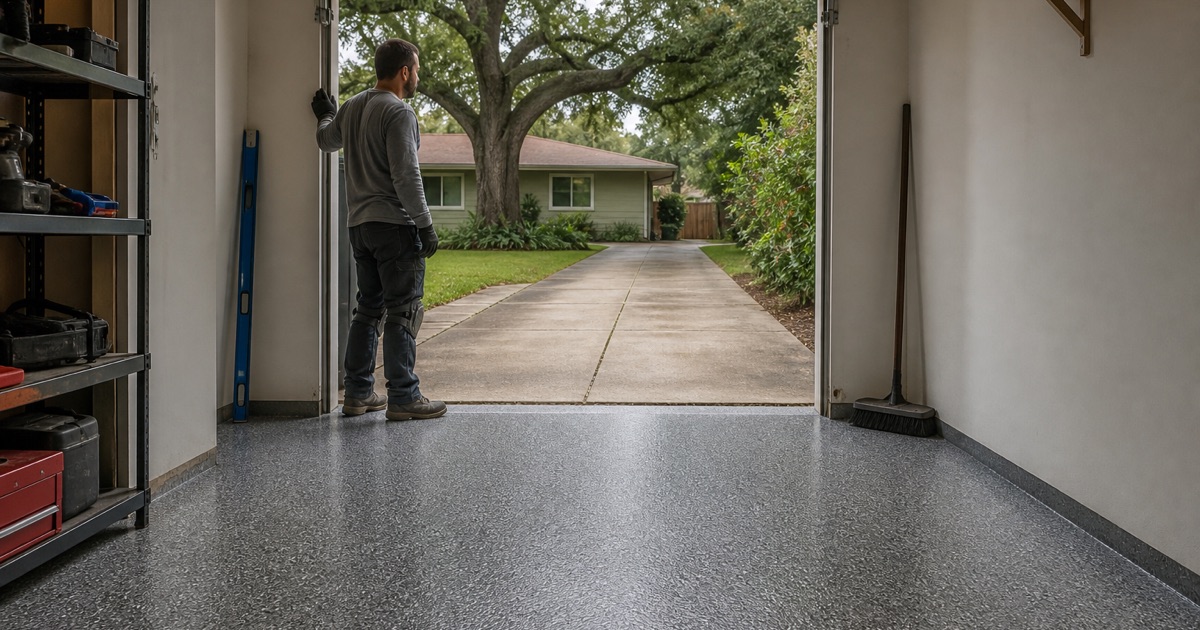
These garages are also frequently detached and set back at the rear of the lot at the end of a driveway run. Every bucket, every bag of aggregate, every length of hose and every grinder and vacuum makes that trip, and the vacuum still has to reach the whole floor from wherever the power is.
That distance gets measured at the estimate rather than absorbed on the day. A crew staging material well back from the work moves slower than one working off a driveway apron, and a quote that ignored the difference is a quote that gets revised in front of you.
The slab, and the ground holding it up
Expansive clay over shallow rock
The soil survey at the city centroid maps Purves clay on 1 to 3 percent slopes, with Purves at 89 percent of the map unit. It is a clayey, smectitic, thermic Lithic Calciustoll, rated well drained, with a maximum horizon clay content of 47.5 percent, a plasticity index of 33 and linear extensibility of 8.4 percent.
Both halves of that description matter. The shrink-swell rating is high, but Lithic means limestone bedrock within roughly 20 inches of the surface, so the layer doing the swelling is thin and sits on rock. That is a different movement regime from deep prairie clay and a genuinely different anchoring problem.
Cracks read as active or dormant before they are filled
A slab that moves with the season will telegraph through a rigid coating wherever it opens a crack, so the existing cracks get read before they get filled. A joint treatment chosen for a static slab will fail on a moving one inside a single season.
Where a crack is still working it is routed out, filled with a semi-rigid polyurea joint filler and carried through the coating as a joint. You are told before the job that a detail like that can show through again, because a coating is a bonded film that follows the slab underneath it.
Two build eras sitting on adjacent blocks
Just under a quarter of the housing here was built in 2010 or later, and post-tension slabs became common in Texas after about 1980. That places the newer stock in the post-tension era and most of the older stock outside it, with the two frequently a block apart.
Which one is underfoot is a site question rather than a neighborhood question. Anything that cuts, cores or anchors into a post-tension slab waits until the tendons are located, and on an older slab the governing question becomes the moisture history instead, which is why testing goes into the scope as a priced line on an older floor.
Whatever the era, the slab is opened mechanically, by diamond grinding or shot blasting, to an ICRI CSP profile chosen for the system going over it. We do not acid etch and we do not lay a new coating over an existing sealer.
Texas licenses no flooring contractor, so instead of a license number we show our City of Killeen general construction registration, our general liability cover, our workers’ compensation and our Texas sales and use tax permit.
- 20+ Years Experience
- Insured & City Registered
- Free Estimates