
Killeen Epoxy Flooring installs metallic epoxy floor systems in Killeen, TX and has been coating concrete here for more than 20 years, serving surrounding cities including Fort Hood, Harker Heights, Nolanville, Copperas Cove and Belton. A metallic floor is the one system we sell where the finished appearance is not fully predictable, and being straight about that up front is most of what separates a customer who loves the floor from one who is disappointed by it.
The effect comes from reflective metallic pigment suspended in a 100% solids epoxy and moved around while the resin is still liquid. The installer floats, blows, drags and puddles the material, and the pigment migrates through the wet film into veins, pools and pearl-like depth. When it cures, that motion is locked in permanently.
That also means the floor is technique-dependent and one of a kind. Two bays coated the same day from the same kit by the same installer will not match each other exactly. We plan around that rather than promising around it.
How a Metallic Floor Is Actually Built
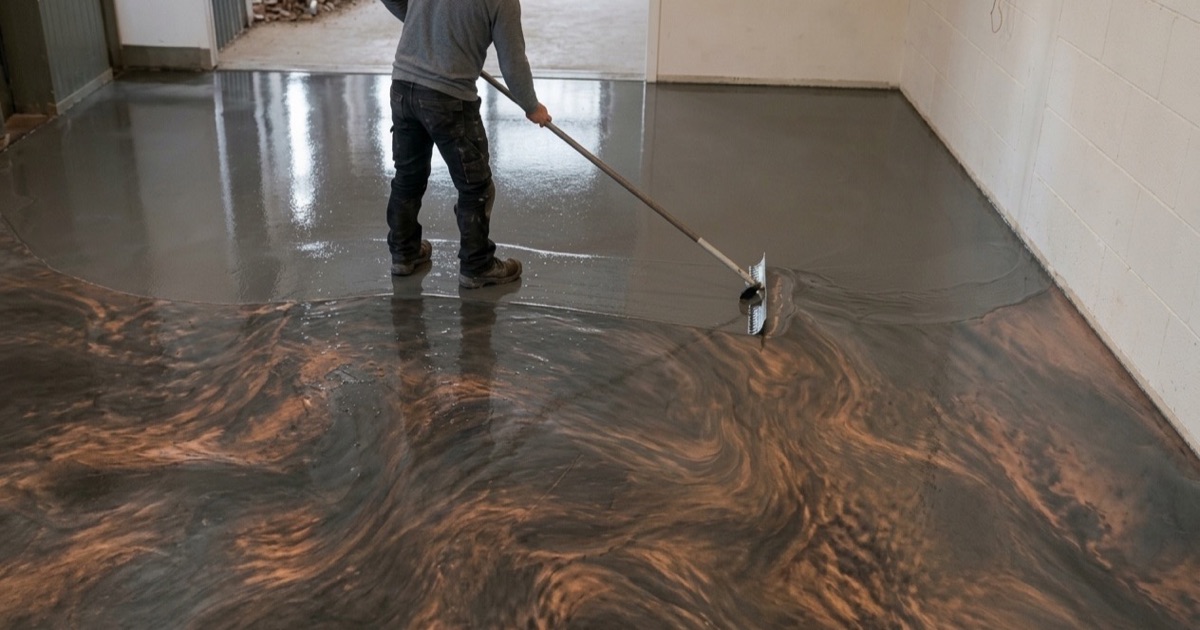
The word metallic describes one layer of a three-part system, and what sits under and over it decides how the floor wears. The pigmented resin is the part people choose; the primer beneath it and the clear wear coat above it are the parts that determine whether the floor is still intact in five years.
The Primer and Body Coat
A metallic system starts on prepared concrete with a primer, and where testing calls for it, a moisture-mitigation primer rather than a standard one. A base coat, usually a solid dark or neutral color, follows and gives the metallic layer something consistent to read against. Skipping the base is how a floor ends up with the shadow of the old slab showing through the pattern.
The Metallic Coat Itself
The pigmented resin goes down at a deliberate mil build, because thickness is what gives the effect room to develop. Spread too thin, a metallic floor looks flat and streaky rather than deep. This layer has to be placed, worked and finished within its pot life, which is why crew size and slab temperature are planned before the material is opened.
The Clear Topcoat
Nothing about the metallic layer is wear resistant on its own, so it is sealed under a clear coat, usually a polyaspartic or polyurea. That topcoat carries the abrasion, sets the gloss level, and is the layer that can be sanded and renewed years later without touching the artwork underneath.
Why No Two Metallic Floors Are Alike
This is the conversation we have before a deposit rather than after an install, because expectations are the thing most likely to go wrong on this system. A customer who has seen one photograph and pictures an exact copy of it is going to be disappointed by a process that cannot produce one, however well the floor is installed.
A Photograph Is a Direction, Not a Specification
Bring us an image you like and we read it for what it tells us: the color pair, how much contrast you want, whether the veining should be tight and busy or broad and slow, and whether the floor is light with dark movement or the reverse. We hit that direction reliably. We cannot reproduce the individual pattern in the picture, and neither can anyone who says otherwise.
A Sample Panel Made With Your Materials
Where the decision is close, we make a sample panel from the same pigment and resin intended for your job. Gloss and depth photograph badly, so a panel settles color questions a screen cannot, and it shows the range you might land in rather than one flattering result.
Where the Seams and Terminations Fall
A metallic pour has to be kept wet edge to wet edge, so on a large or awkwardly shaped floor we plan where a section break lands. Placing that break at a doorway, a column line or a saw cut hides it. Discovering it in the middle of an open room does not.
Where a Metallic Floor Suits, and Where It Does Not
Showrooms, Retail and Interior Living Space
Metallic finishes do their best work where people look at the floor: retail floors, salons and studios, medical and dental waiting rooms, offices, entryways and interior living space. The depth reads as expensive under good light, and light foot traffic never challenges the topcoat.
Garages and Personal Shops
Plenty of the metallic work we do here is residential garages, and the system handles it well when the topcoat suits the duty. A garage storing a collection is a different job from one where a work truck parks hot every evening, and we specify the clear coat accordingly.
Where We Would Point You Somewhere Else
We do not recommend a metallic floor in a commercial kitchen, where the Texas Food Establishment Rules in 25 TAC Chapter 228 push you toward urethane cement with an integral coved base. We would not put one outdoors in full sun, where an aliphatic system on a light color makes far more sense. And we would steer a warehouse aisle with steel-wheeled traffic to a solid-color industrial build instead, because scratches show on a reflective floor in a way they never do on a flake floor.
What the Slab Underneath Decides
A metallic floor is unforgiving of the concrete it sits on, more so than a flake or solid-color system, because a mirror-like surface reports everything beneath it. A flake broadcast hides a slight dish or a patched area; a reflective finish draws the eye straight to it and makes it look deliberate.
Flatness and Reflection
Trowel ridges, birdbaths and slight dishing are almost invisible on a matte floor and obvious on a glossy one, which reflects a straight ceiling line as a wavy one. We say before quoting whether your slab needs flattening to get the result you are picturing.
Cracks Under a Decorative Finish
Killeen sits on San Saba clay, a smectitic Vertisol running near 50% clay with a plasticity index of 40 and a linear extensibility around 10%, and slabs on it move with the season. The coating is a film a few thousandths of an inch thick and follows the slab exactly. A working crack is routed and filled with a semi-rigid polyurea joint filler and carried through as a joint, and you are told before the job that it can reappear.
Moisture, and Why It Costs More Here Than Elsewhere
Vapor pressure from below blisters a coating, and on a metallic floor a blister cannot be spot-repaired invisibly the way a solid color can. That is why testing to ASTM F1869, ASTM F2170 or ASTM D4263, read against ASTM F710 thresholds, goes into the scope on an older slab as a line item rather than being sold afterward.
Gloss, Grip and Living With the Floor
Choosing a Gloss Level
High gloss maximizes depth and also maximizes what shows: dust, footprints and fine scratches. A satin topcoat gives up some drama and is markedly easier to live with in a busy room. We would rather you make that trade knowingly than default to the glossiest option.
Slip Resistance Without Losing the Effect
Grip is added by suspending a fine polymer or aggregate additive in the clear coat, which raises the coefficient of friction while leaving the pattern visible. On any floor that gets wet, and on ramps and steps, this is not optional.
Cleaning, Wear and Renewal
Routine care is a dust mop and a neutral cleaner; abrasive pads and harsh chemicals dull the topcoat. When the clear coat eventually wears in the traffic path, it can be abraded and recoated, which restores the finish without disturbing the metallic layer under it.
- 20+ Years Experience
- Insured & City Registered
- Free Estimates