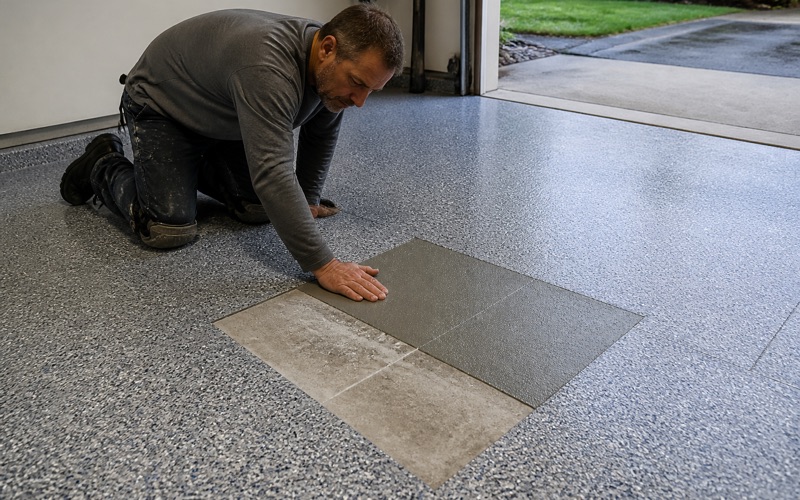
Killeen Epoxy Flooring installs epoxy flooring in Nolanville, and after more than twenty years on Central Texas slabs we quote the ground before we quote the product. The soil under this city is a high-plasticity clay that changes volume with the season, and it decides the crack detail on a garage floor far more than the coating does.
That is also why our proposals name the product, the system build and the finished mil thickness. A number you can check against what actually went down is worth more than a brand name, and it is the only honest way to compare two quotes that both say epoxy on the cover.
And it is why moisture testing appears on an older slab as a line item in the scope rather than as an extra invoiced after a floor has blistered. The ground here holds water in a particular way, and a slab in this city can be wet at the underside on a day the surface reads bone dry.
Ground that expands and contracts as one body
What the soil survey reads under this city
The USDA soil survey at the Nolanville city centroid maps Lewisville silty clay on 1 to 3 percent slopes, with Lewisville making up 85 percent of the map unit. It is a fine-silty, mixed, active, thermic Udic Calciustoll, rated well drained, carrying 46 percent clay and a plasticity index of 29 within the surface horizon.
Linear extensibility is 7.5 percent at the surface, 7.5 percent from 39 to 97 centimeters, and 7.5 percent again from 97 down to 175 centimeters. Clay content drifts between 41 and 46 percent across those layers and the plasticity index between 26 and 29, but the swell figure does not change with depth at all.
Uniform movement is still movement
A profile carrying the same linear extensibility all the way down expands and contracts as one body rather than in layers. That tends to lift and settle a slab more evenly than a stacked profile does, and even movement is genuinely kinder to a bonded coating than differential heave, which racks one part of a slab against another.
It is not the same thing as a still slab. Seven and a half percent is real seasonal movement, and a crack that opens in a dry August has not finished moving. It has simply reached one end of its travel.
Why that changes the crack detail rather than the product
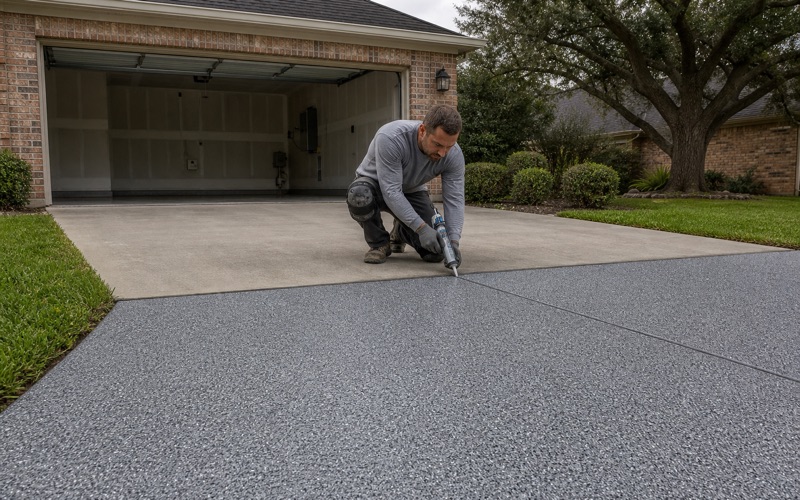
So we read the cracks before we pick a system. A crack over ground that is still working gets treated as a joint that is still working: routed out, filled with a semi-rigid polyurea joint filler and carried through the coating as a joint, instead of filled hard and skimmed over so it looks solved on the day.
You are told before the job that a detail like that can telegraph again, and substrate movement is named first in the warranty exclusions we read out before anything is sold. A coating is a film a few thousandths of an inch thick. It follows the slab underneath it and nothing changes that.
Looking for epoxy flooring closer to Copperas Cove? See Epoxy Flooring in Copperas Cove.
Water that does not drain, and a slab wet from below
A saturated hydraulic conductivity of 0.91 micrometers per second
The same soil record puts saturated hydraulic conductivity at 0.91 micrometers per second, and it holds that figure at every depth in the profile. That is slow. Water arriving at this ground does not move down through it quickly.
Where water cannot drain it sits, and where it sits beneath a slab it keeps feeding vapor upward through the concrete. That is a background condition here rather than a storm event, and it is present on perfectly ordinary weeks.
The surface and the vapor drive are not telling the same story
A garage floor in this city can look, feel and sweep dry while the underside of the same slab is still in contact with wet ground. The top few millimeters respond to the air inside the garage. The vapor drive through the slab responds to what is under it.
Judging that by eye, or by whether it has rained lately, is how a coating gets installed onto a slab that is going to push it straight back off. Adhesion loss from moisture usually shows up as blisters, or as a film that lifts in sheets weeks after the crew has gone.
Why an epoxy fails from underneath more often than from wear
Most failed residential epoxy we are called out to look at is not worn out. It is debonded, with the film still intact and the concrete no longer holding it, and that is a moisture story far more often than it is a product story.
That is worth knowing before choosing between systems on price alone. The most reliable way to spend money twice on a garage floor in this city is to buy a good coating and lay it onto a slab nobody tested first, because the resin is not the part that gave way.
Testing slab moisture instead of judging it by the weather
Calcium chloride and relative humidity, not a look
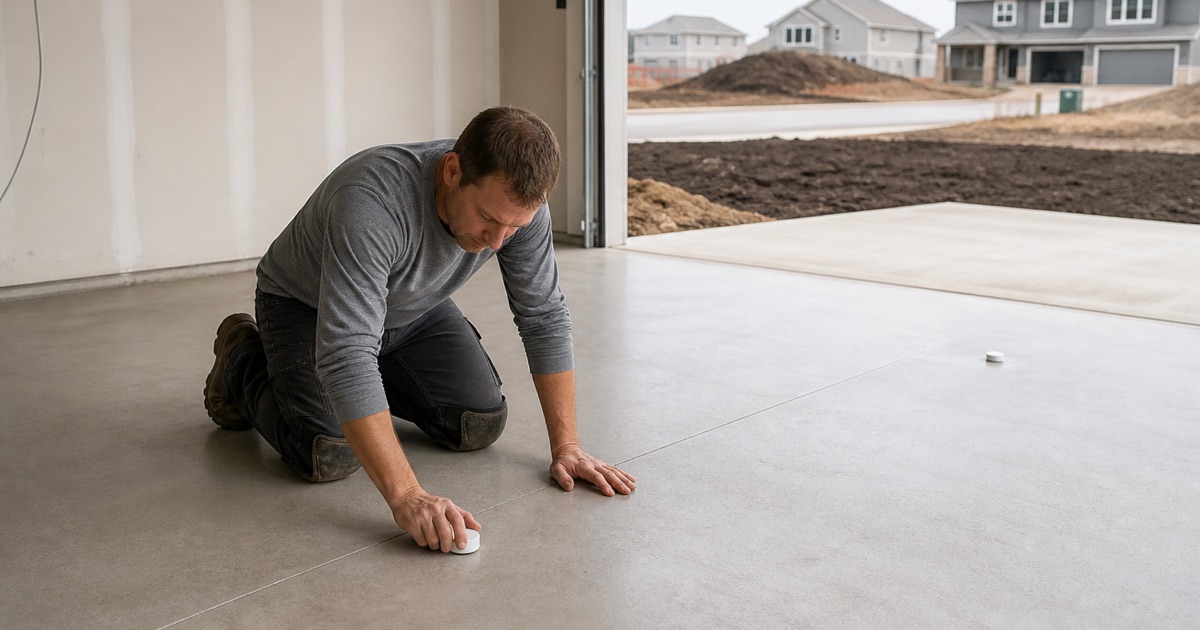
On any slab where the age or the history warrants it, we test. ASTM F1869 measures a moisture vapor emission rate with calcium chloride at the surface. ASTM F2170 puts relative humidity probes down into the slab itself and reads what the concrete is carrying internally.
The two answer different questions, and the in-situ probe is the harder one to argue with, because it reads the body of the slab rather than what happens to evaporate off the top over three days.
The quick check and the thresholds
ASTM D4263, the plastic sheet taped down overnight, is a screen and not a result. It can tell you a slab is obviously wet. It cannot tell you a slab is dry enough, and it is no substitute for a number on a page.
ASTM F710 sets out how the concrete is assessed and where the thresholds sit, and manufacturers publish their own limits against those tests. We put the readings in front of you rather than summarizing them for you as fine, because that figure is what decides whether a primer belongs under the build.
What the numbers change in the scope
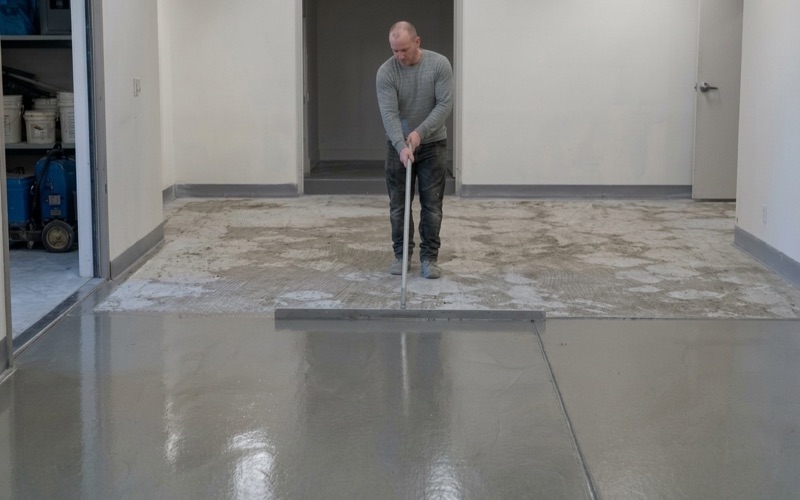
If the readings come back above the system’s limit, the answer is a moisture-mitigation primer underneath the build, and it is priced in the proposal before the job starts. It does not arrive afterward as a rescue.
If they come back inside the limit, nothing is added and nothing is charged for it. The whole point of testing is to make that a decision with a figure behind it instead of an assumption in either direction.
Post-2000 subdivision garages and the slab underneath them
A predictable bay
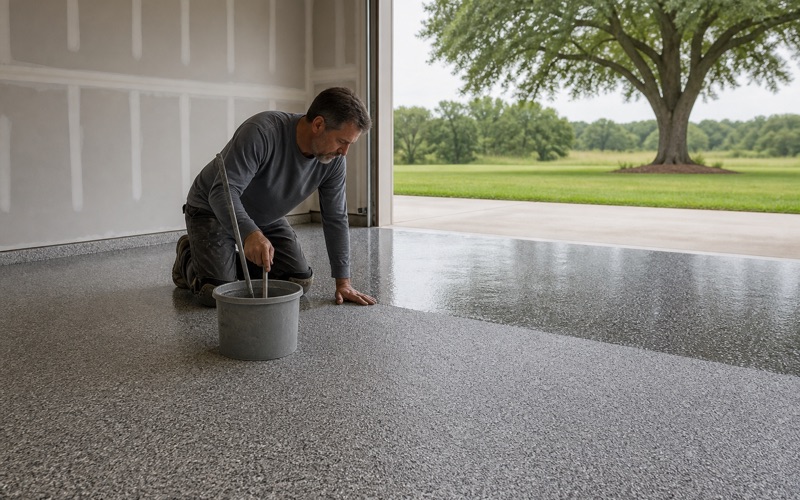
Nearly three quarters of the housing in this city was built in 2000 or later, and the stock has roughly tripled since then. The addressable garage is usually an attached two-car bay off a short front driveway in a platted subdivision.
That predictability is worth something on a quote. Area, door width and driveway approach fall into a narrow range, so an estimate that holds on one house tends to hold on the next, and a slab that young means preparation is removing ordinary use rather than fifty years of it.
The city runs its own Building Permits and Inspections department alongside Planning and Development, and the counter here stays busy relative to the town’s size because it is processing new subdivision work rather than maintaining a static stock. A floor coating is not a permitted alteration; structural repair to a slab is, and it takes its own permit.
Post-tension as the default assumption
Texas residential construction is slab-on-grade almost without exception, and post-tension slabs became common across the state after about 1980. With 88.8 percent of the housing here built in 1980 or later, we assume a post-tension slab until the drawings or the slab itself say otherwise.
That assumption governs anything that breaks the surface. Cutting a control joint, coring a drain or driving an anchor without knowing where the tendons run risks a cable, and on a slab this young it is the single most expensive mistake available on a floor coating job.
Preparation, and the two things we will not do
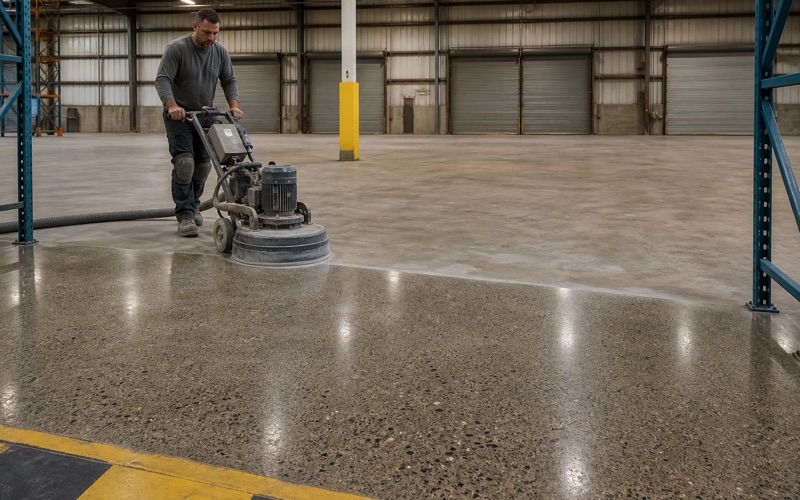
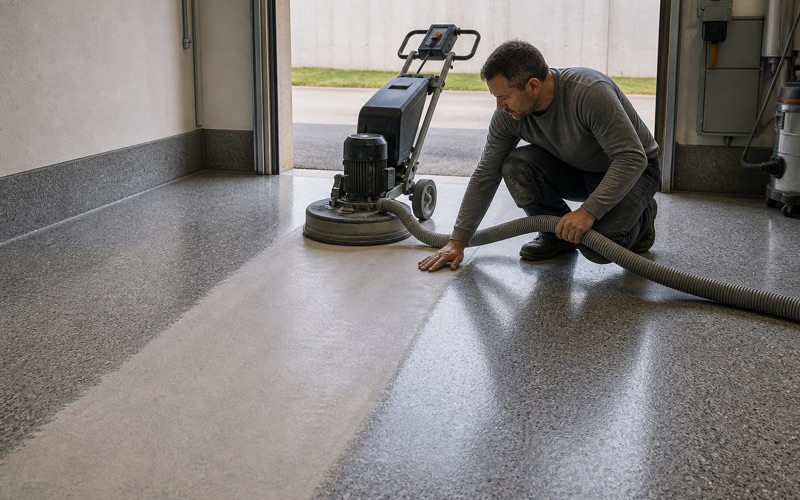
Every slab is opened mechanically, by diamond grinding or shot blasting, to an ICRI CSP profile chosen for the system going over it. The profile is selected for the build rather than applied by habit, and diamond segment bond hardness is matched to concrete of this age and hardness.
We do not acid etch, and we do not lay a new coating over an old sealer. Both are shortcuts around preparation, and both rest the adhesion of the entire floor on something we did not put down and cannot vouch for.
Texas licenses no flooring contractor, so there is no license number for anyone in this trade to show you here. What we can show is our City of Killeen general construction registration, our general liability cover, our workers’ compensation and our Texas sales and use tax permit.
- 20+ Years Experience
- Insured & City Registered
- Free Estimates