
Killeen Epoxy Flooring installs polished concrete flooring in Killeen, TX and across the surrounding cities including Fort Hood, Harker Heights, Nolanville, Copperas Cove and Belton, with more than 20 years of grinding and polishing behind the work. Polished concrete is not a coating at all — it is the slab you already own, ground and refined until it is dense, hard and reflective.
That difference matters more here than it does in most markets. A coating is a film bonded to the top of a slab and it can lose that bond, most often to moisture driving up from underneath. Polished concrete has no film to debond, so on a slab with a genuine vapor drive it can be the more honest answer than a coating that will blister within the year.
What it cannot do is hide. Grinding exposes what is in the concrete — the aggregate, the color variation, the old repairs and the cracks — and refines it rather than covering it. We tell you what your slab is likely to look like once it is opened up, before you commit to a finish that cannot be walked back.
What Polished Concrete Flooring Actually Involves
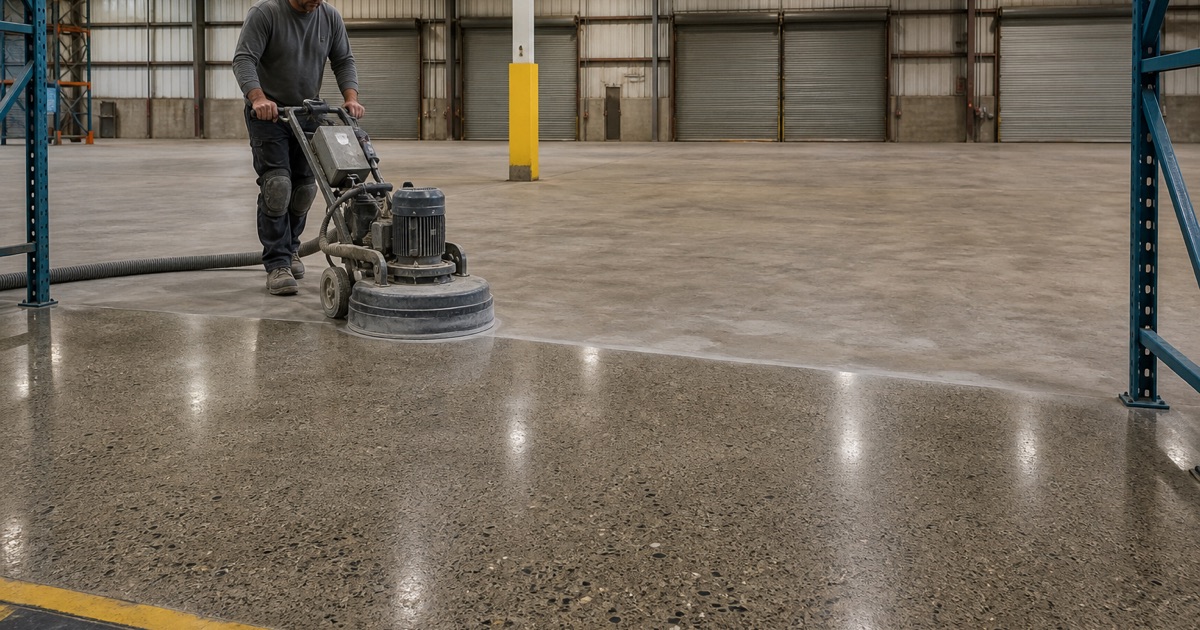
Grinding, Honing and Polishing in Stages
Polishing runs through a sequence of progressively finer diamond abrasives, starting with metal-bonded segments that cut and moving to resin-bonded discs that refine. Each pass has to remove the scratch pattern the previous one left. Skipping grits is how a floor ends up looking cloudy under raking light, and it cannot be corrected by adding gloss at the end.
Densifying the Surface
Between passes the slab is treated with a lithium silicate densifier, which reacts with free lime in the concrete to fill the pore structure and harden the surface. That is what makes a polished floor abrasion-resistant rather than merely shiny. A floor sold as polished but never densified is a ground floor with a coat of gloss on it, and it wears through in traffic lanes.
Aggregate Exposure, Decided in the First Cut
How deep the first cut goes decides what you see: a cream finish leaves the surface paste, a salt-and-pepper exposure shows fine aggregate, and a full exposure opens the stone. This is set in the opening pass and cannot be changed afterward without starting again. We agree the exposure standing on your slab, not from a brochure.
Commercial Polished Concrete
Warehouse and Distribution Floors
A polished slab suits high-traffic warehouse floors because there is no film for a forklift wheel to scuff off and no coating edge at a joint to chip. Maintenance is mechanical rather than chemical. The honest caveat is that polishing does not repair a slab that is already spalling, and joints still need their own detailing.
Retail, Showroom and Institutional Floors
In a retail or institutional space the appeal is a hard, low-maintenance floor that reads as a deliberate finish rather than as a compromise. It handles rolling loads and heavy foot traffic without the recoat cycle a coated floor carries. Where a specification calls for a measured slip resistance, that has to be addressed deliberately, because a high-gloss polish is not automatically compliant.
Working Around an Operating Business
Polishing is a dry, dust-controlled process with no solvent odor and no cure time, so a section can be handed back the same day it is finished. That makes it far easier to phase around a business that cannot close than a coating with a recoat window. We sequence the floor in bays and tell you what each one costs in downtime.
Residential Polished Concrete
Interior Living Floors
Inside a house, polished concrete gives a hard, seamless floor with no grout lines and nothing to lift, and in this climate it stays cool underfoot. It is unforgiving of a slab that was never poured with a finished floor in mind, so we assess yours before recommending it. Where the slab was covered by tile or carpet for decades, the adhesive residue has to come off first.
Garages, Shops and Patios
A polished garage slab is a lower-maintenance alternative to a coating and it will not pick up under a hot tire. It offers less chemical protection than a full-build epoxy, so on a bay that sees oil and brake fluid regularly a coating is usually the better specification. We say which one your use actually calls for rather than selling the one with the higher ticket.
Grades, Gloss and What You Are Choosing
Gloss Level and What It Costs to Reach
Gloss is a function of how far up the grit sequence the floor is taken, so a higher gloss is more passes and more money rather than a different product. A satin-level finish hides ordinary wear and dust; a high polish shows both. In a working space the mid-range is usually the right economic answer.
Stains, Dyes and Saw-Cut Detail
Concrete dye applied during the polishing sequence penetrates the surface and takes color into the slab rather than laying it on top. Saw-cut lines and borders are cut into the substrate and cannot be added later. Both are decided before polishing starts, and we lay them out on the floor with you.
What Polishing Will Not Fix
Polishing does not level a slab, close a moving crack, or rescue a surface that has already delaminated. Where the concrete itself has failed, resurfacing has to come first and the polish goes on the new surface. We are direct about this before quoting, because a polished floor over bad concrete is an expensive way to highlight the problem.
Our Polished Concrete Process
Slab Assessment and a Test Patch
We look at the slab, check its hardness and its condition, and on anything uncertain we grind a test patch so you can see the actual aggregate and color before committing. That patch is the most useful thing in the whole quoting process, because no sample board shows what is inside your particular pour.
Repairs and Joint Treatment First
Spalls, old anchor holes, previous patches and control joints are addressed before polishing begins, using fillers chosen to take a polish rather than to sit proud of it. Moving joints are filled semi-rigid so they can still work. Doing this after the grinding sequence has started means re-running passes that were already paid for.
The Grinding and Densifying Sequence
Metal-bonded diamonds cut to the agreed aggregate exposure, then the slab is densified with lithium silicate, then resin-bonded discs refine the surface up through the grit sequence to the specified gloss. Each pass has to clear the last one’s scratch pattern, and we work to the sequence rather than skipping grits to save a day.
Guarding, Handover and Maintenance
A protective guard is applied to help the surface shed staining, and we hand over with the cleaning regime written down — neutral-pH cleaner, no wax, no stripping. There is no cure period, so the floor is in service immediately. We also tell you when a burnishing pass will be worth doing.
- 20+ Years Experience
- Insured & City Registered
- Free Estimates