Killeen Epoxy Flooring has handled pool deck resurfacing across Killeen, TX for more than 20 years, serving surrounding cities including Fort Hood, Harker Heights, Nolanville, Copperas Cove and Belton. A pool deck is the most demanding slab on most properties to coat well, because it is asked to do four things at once: stay cool enough to stand on barefoot, stay grippy when it is soaking wet, hold its color under direct sun, and shrug off chlorinated water splashed over its edge a few hundred times a summer.
Those four demands pull against one another. Texture coarse enough to grip well is texture that scuffs knees and traps dirt, and a dark color that hides pool chemicals is a dark color that gets hot enough to move people off it by mid-afternoon. Most of our work on a deck is deciding where on each of those scales your family actually lives, then building a system that lands there rather than the one that photographs best.
One thing we say before we quote any deck: the ground under this city is San Saba clay, a smectitic Vertisol running near 50% clay with a plasticity index of 40 and a linear extensibility around 10%. That is a very high shrink-swell rating, and a resurfacing system is a bonded film a few thousandths of an inch thick. It follows the slab exactly. Nothing we install will stop, bridge or absorb seasonal ground movement, and any contractor who tells you otherwise is selling something a coating cannot do.
Coating Systems That Survive Sun and Splash-Out
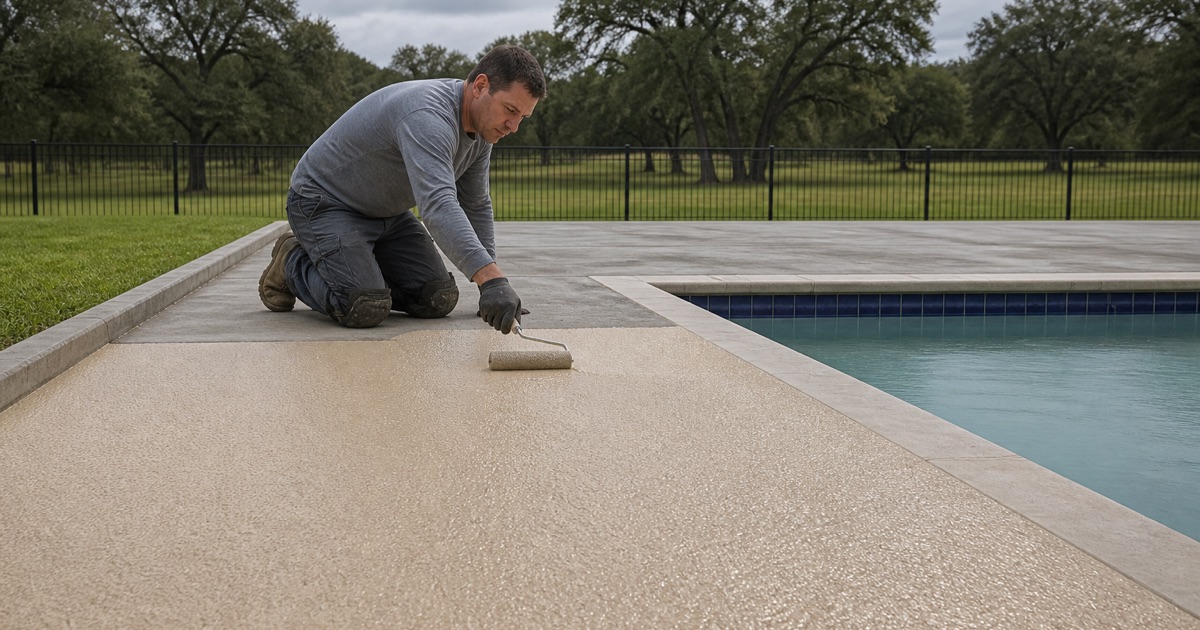
Exterior work rules out much of the product shelf before we start. A pool deck is a UV problem first and a wear problem second, which reverses how an indoor floor is specified.
Aliphatic Polyaspartic and Polyurea Topcoats
The wear coat on a deck is aliphatic — a polyaspartic or polyurea — because that chemistry is UV stable and holds its color in full sun. It also cures fast enough to get a deck back in service quickly.
Where a Standard Epoxy Belongs and Where It Does Not
A 100% solids epoxy is a superb body coat and a poor exterior finish coat: it ambers under sunlight and loses gloss unevenly, so on a deck it stays underneath as the build layer, sealed by an aliphatic top. On a shaded deck with a solid roof over it that trade-off softens, and we will say so rather than upsell you a coat you do not need.
Mil Build and Spread Rate, Written Into the Proposal
Every deck proposal names the product, the system build and the finished mil thickness, so what was quoted can be checked against what went down. Spread rate is how a coating either reaches its stated thickness or quietly does not.
Slip Resistance When the Deck Is Wet
Slip resistance is the one specification on a pool deck with no acceptable compromise, and it has to be judged wet rather than dry. A finish that grips well dry can be treacherous under a film of water and a trace of sunscreen.
Coefficient of Friction, and Building It In Rather Than On
We build texture into the system with a broadcast aggregate or a graded additive suspended in the topcoat, so the grip is part of the coating rather than a gritty layer sitting on the surface waiting to wear off the traffic path first. That means the coefficient of friction the deck has in year one is close to what it has in year five.
Grading Texture to the Actual Surface
We grade texture by zone. The walking ring around the coping and the steps get the most aggressive profile, lounging areas get a finer one, and a barefoot deck never gets a quartz aggregate broadcast coarse enough to scrape a child who slides across it. Tell us how the deck is used and we map that with you before anything is mixed.
Heat Underfoot and the Cool-Decking Question
Surface temperature is the complaint we hear most from people who inherited a dark deck with a house. Color governs it far more than product does — a light, reflective finish stays usably cooler in direct sun than a dark one under the identical coating.
Color, Reflectivity and Flake Blends
A light base with a vinyl flake broadcast in mid-tones is usually the best answer, because the flake hides dirt and pool chemical staining that a plain light deck would show, while the overall reflectivity stays high. If you want a genuinely dark deck, we would rather tell you what it will feel like in August than hand it over and hear about it later.
Thermal Cycling on an Exterior Slab
An exterior deck moves twice: seasonally with the clay underneath it, and daily with its own heating and cooling cycle. That second movement is why terminations matter outdoors. Edges, coping joints and drain surrounds are where a poorly detailed deck starts lifting, so we terminate into a cut or a coping line rather than feathering a coat out to nothing.
Chlorinated Water, Deck Chemistry and Drainage
Splash-out is a chemical exposure, not just water. Pool water carries chlorine or salt, and the deck also takes shock treatment spills, sunscreen, leaf tannin and fertilizer overspray from the yard.
Chemical Resistance Where the Deck Meets the Water
The strip of deck nearest the coping takes a genuinely different duty than the rest of it, and that is where we specify the most chemical-resistant build in the system. Salt systems are harder on a coating than people expect.
Drainage, Deck Drains and Standing Water
Standing water is the enemy of every exterior coating, and a deck that ponds telegraphs that pond as a dull patch within a season or two. We check fall toward the drains before quoting and say plainly if the concrete itself needs correction a coating cannot supply.
What We Check Before Quoting Your Deck
An exterior slab hides different problems than a garage floor does, so the assessment is different too. Sun, standing water and thermal cycling all act on it daily, and the concrete has usually been sealed at some point by someone who is no longer around to say what they used.
Moisture Rising Through a Slab-on-Grade Deck
A pool deck sits on ground that is wet by definition. We run an ASTM D4263 plastic sheet test as a first read and, where the deck is older or the reading is ambiguous, ASTM F1869 calcium chloride or ASTM F2170 relative humidity probes measured against ASTM F710 thresholds. That testing goes in the scope as a line item, not sold as an extra after a deck has already blistered.
Cracks Treated as Joints That Are Still Working
A crack over clay that moves is not a defect to be filled hard and coated over. We route it out and fill it with a semi-rigid polyurea joint filler, then carry it through the finish as a joint, and we tell you before the job that it may telegraph again after a wet winter or a long dry summer.
Scheduling Against the Dew Point at the Slab
Dew point governs an exterior pour more than air temperature does. The slab surface must sit at least 5 degrees above the dew point when we coat, and Killeen forecast dew points have run from 58 to 72 degrees with relative humidity between 24 and 85 percent. That is why a summer crew on your deck starts mid-morning rather than at first light, and why pot life shortens from around 60 minutes at 55 degrees to roughly 20 minutes at 95.
- 20+ Years Experience
- Insured & City Registered
- Free Estimates