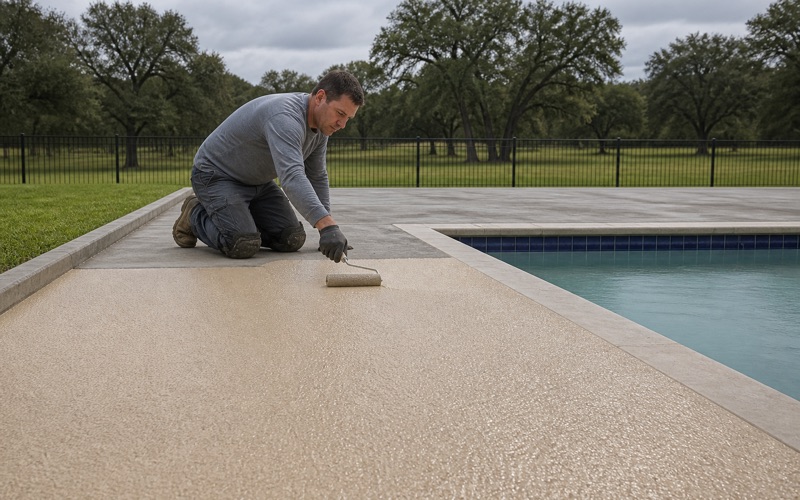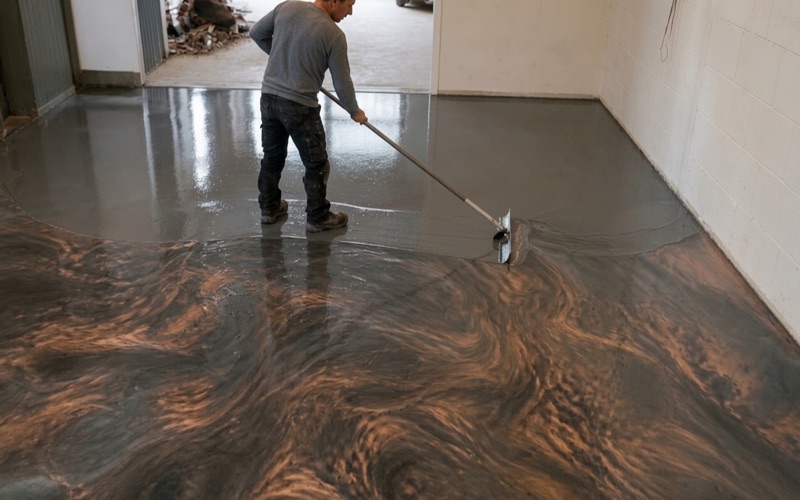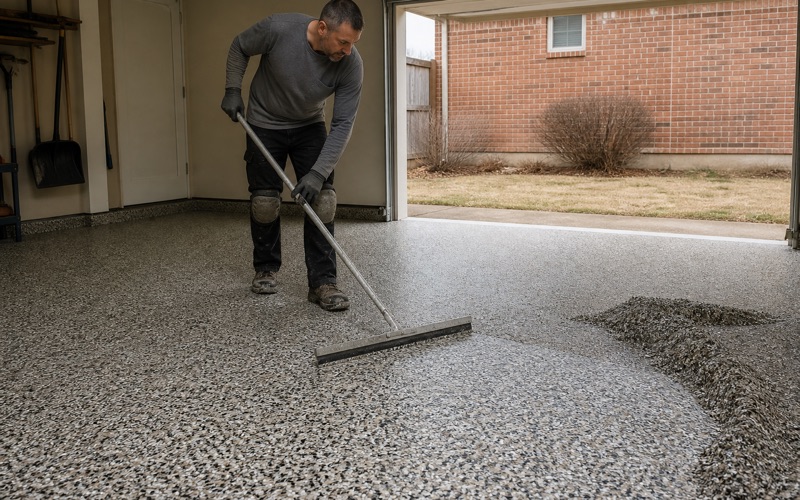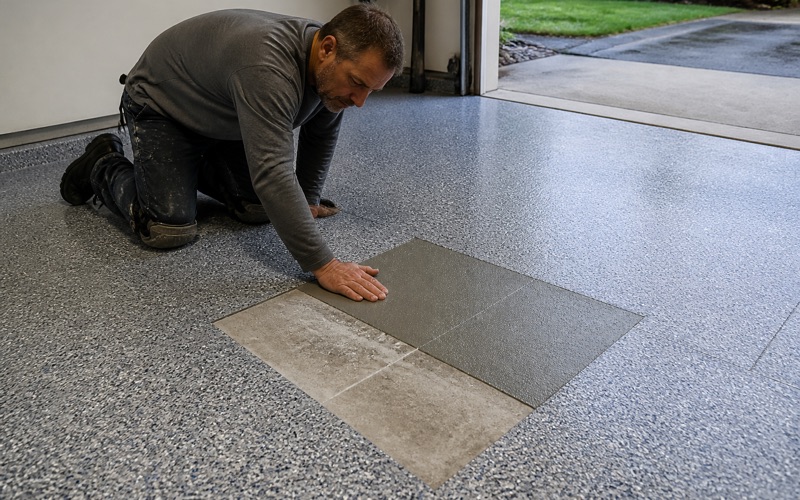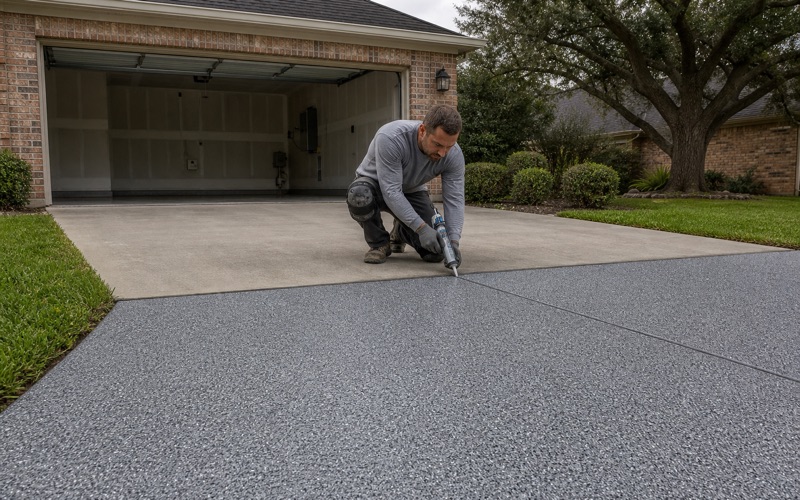
Killeen Epoxy Flooring installs epoxy flooring in Santa Rita Ranch, and nearly every slab we are asked to coat here is a first coating on original builder concrete. That is a different job from the one this trade is usually pictured doing. It is easier in some ways and harder in others, and both halves are worth saying out loud.
Easier, because there is no failed system to reclaim, no forty years of oil driven into the pores, and no history of patches and repairs to unpick before anything can go down. Harder, because a young slab has its own failure modes, and all of them are invisible until a coating lifts off one.
There is also a governance question here that catches owners and contractors alike, and a slab question that has to be settled before a blade or an anchor goes near the concrete. Both have answers. Neither should be guessed at, and this page works through them in that order.
Garages with no history, and what that removes from the job
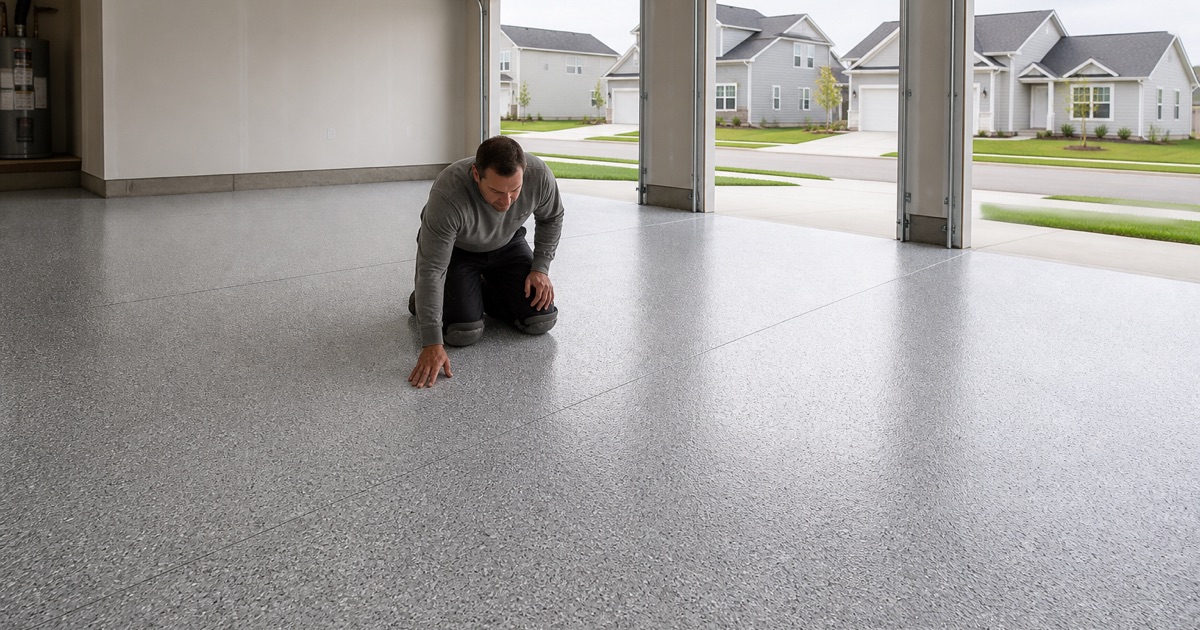
A build cohort with essentially no older half
Of the housing units recorded in this census-designated place, 96.9 percent were built in 2010 or later — 49.7 percent through the 2010s and 47.1 percent in 2020 or later. About one percent dates to 2000 through 2009, and the record shows nothing at all from the 1990s, nothing from the 1970s, and nothing earlier.
The counts behind those shares carry wide margins of error, so we do not quote them to the unit. The direction is not in any doubt: almost every garage slab here is under fifteen years old and a great many are under five. That is a first-coating market rather than a repair market and it should be priced as one.
Two- and three-car bays, and what owners ask of them
Homes here run from roughly 2,238 square feet to nearly 4,900 on 50- to 70-foot home sites, with two-car and three-car garages across the builder range. A three-car bay is a large floor by residential standards, and it is rarely being used to park three cars.
What it is being used for decides the system. A workshop end takes dropped tools and solvent, while a gym end takes point loads and wants measurable slip resistance.
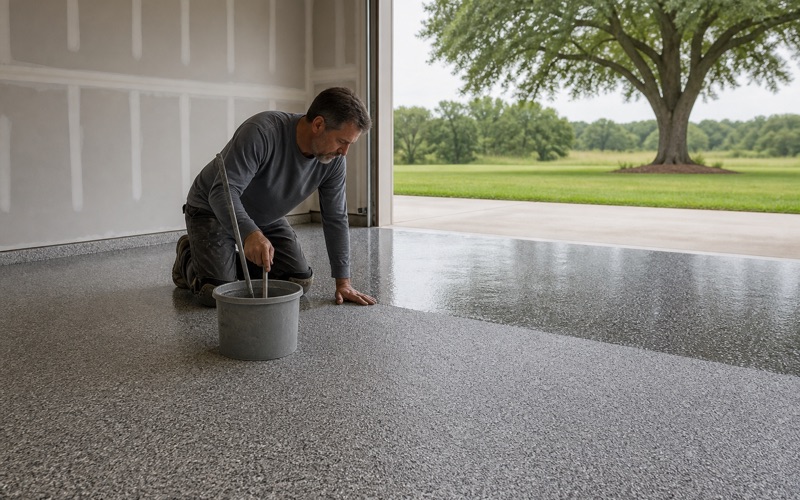
A bay carrying a daily driver takes hot tire pickup, which is the failure that a thin, under-built or under-cured film shows first. A vinyl flake broadcast under a polyaspartic topcoat covers most of that, and a quartz aggregate broadcast covers the rest.
A new slab is not an easy slab
Three things go wrong on young concrete and none of them show on a walkthrough. It may still be releasing moisture from the original pour. Its builder finish is power-troweled dense and closed, which no coating bonds to properly. And cure-and-seal or curing compound left on the surface is a bond-breaker sitting exactly where the adhesion has to happen.
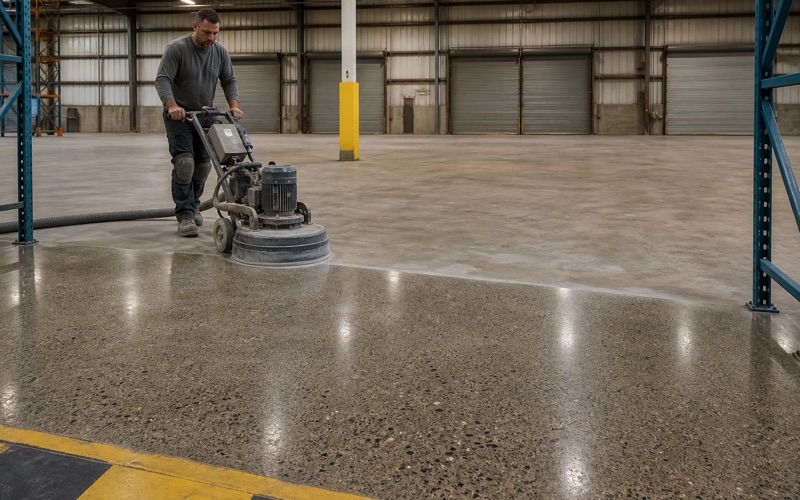
All three are handled the same way. The slab is opened mechanically with a grinder or a shot blaster to an ICRI CSP profile matched to the system going over it. We do not acid etch and we do not put a coating over an existing sealer or curing compound. On hard, dense builder concrete the diamond segment bond hardness has to be chosen for that slab, or the tooling glazes and takes nothing off.
Looking for epoxy flooring closer to McGregor? See Epoxy Flooring in McGregor.
Who governs here, when it is not a city
No city government and no residential building code
This is a census-designated place — unincorporated, with no city government, no mayor, no city council and no municipal building department. The boundary is drawn by the Census Bureau for statistical purposes rather than by an act of incorporation, which is a finding rather than a gap.
Williamson County states in writing that it has not adopted a resolution or order requiring residential building code standards in unincorporated areas and does not require new residential construction to conform to any building code, that it has no authority to zone property for land use, and that it cannot issue a certificate of occupancy. On a residential garage coating here there is no building official to call and no residential permit to pull, and we would rather say that with a citation behind it than shrug at the question.
The address on the letterbox is not the jurisdiction
Every home here carries a Liberty Hill mailing address on ZIP 78642, and the parcel is not in Liberty Hill. Recorded county plats inside the community carry the note, in those words, that the subdivision lies within that city’s extraterritorial jurisdiction.
A Texas city in its extraterritorial jurisdiction holds subdivision and sign regulation, not building code and not zoning. So the mailing address sends people to a counter with no residential building permit to sell, and the county counter does not have one either. Knowing that in advance saves two phone calls on a garage and about a week on a commercial job.
Utilities, and the one permit that does exist
Water and wastewater run through Williamson County MUD 19H, with Georgetown Utility Systems on the water side and the City of Liberty Hill on the wastewater side. Wastewater here is piped and municipal, which is worth stating because the default assumption about unincorporated Texas land runs the other way entirely. Electric service is Pedernales Electric Cooperative, so a temporary supply or a service upgrade for grinding and extraction equipment goes through a member cooperative’s own process.
There is one construction permit program that does reach this ground: the Williamson County Fire Marshal’s Office, the authority having jurisdiction over the unincorporated county. It administers the 2018 International Fire Code with local amendments, and its stated scope is public buildings, commercial establishments and multi-family dwellings of four or more units — so it reaches a commercial coating job here and does not reach a single-family garage.
A slab that has to be proved before it is cut
Post-tension is the expectation, not a verified fact
Texas construction is overwhelmingly slab-on-grade with basements effectively absent, and post-tension became common after about 1980 and is standard current practice for new Central Texas construction on reactive ground. Applied to a stock built almost entirely since 2010, on ground that is roughly half Vertisol, post-tension is the reasonable expectation here.
It remains an expectation. It has not been verified for this community and we will not tell you that it has. Cutting or coring a post-tension slab can sever a tendon, and a severed tendon is a structural repair rather than a change order, which is why the expectation is treated as a stop rather than as an answer.
What confirmation actually looks like
Before anything is cut, cored or anchored, the slab type is confirmed against the builder’s plan set, the structural drawings, the tendon end anchorages visible at the slab edge, or a scan of the concrete itself. On a house young enough that the builder’s package is still in a kitchen drawer, that is usually a five-minute question rather than an investigation.
Most epoxy work never needs a cut at all, and that is worth saying too. Grinding, profiling, priming and coating take nothing out of the slab. It is anchoring a threshold, doweling a transition, saw-cutting a new control joint or coring a drain that puts a tool into the concrete, and those are the operations we hold until the answer is in hand.
Cracks, joints, and what a coating can honestly promise
A coating is a bonded film a few thousandths of an inch thick. It follows the slab under it and cannot stop, bridge or absorb ground movement. Any claim that a floor coating protects against foundation movement is false here, and it would be false anywhere.
On ground carrying a high-movement layer at slab depth, a crack is a live joint rather than a repair. It gets routed, filled with a semi-rigid polyurea joint filler and carried through the coating as a joint, and you are told before the job that it can telegraph again. On a slab this young there usually is not one yet, which is precisely why that conversation belongs before the floor goes down rather than after something appears.
Ground that moves more than its soil name suggests
Half of this place is Vertisol and half is not
Area-weighted across the whole CDP polygon, Fairlie clay covers 46.9 percent of the surface and Crawford clay 2.3 percent. Both are Vertisols, and together they are just under half the area. The remainder is Mollisols, Inceptisols and rock outcrop — Georgetown at 28.1 percent, Eckrant at 11.8, Brackett and Real at 6.8, Denton at 2.4, Sunev at 1.2 and Doss at 0.4.
Neither of the two easy stories is true. This is not all Blackland clay and it is not all thin limestone soil, and the map unit under one street is not the map unit under the next. Soil here is a per-address question rather than a per-community one, and it is answerable per address.
The majority soil moves more at slab depth, not less
The intuitive reading is that the ground which is not Vertisol is the safe ground. It is not. Georgetown carries 30 percent clay, plasticity index 23 and linear extensibility of 2.5 to 3.9 percent through the top seven inches, then jumps to 70 percent clay, plasticity index 48 and linear extensibility of 8.5 percent from there down to 89 centimeters.
Fairlie’s worst layer, by comparison, is 50 percent clay at plasticity index 41 and linear extensibility 7.5 percent. The Mollisol moves more where a slab actually bears than the Vertisol does, and together those two map units cover roughly three quarters of this place. Both are high shrink-swell at the depth that matters.
Rock underneath, and water with nowhere to go
Fairlie returns no horizon data below 117 centimeters and Georgetown none below 89 centimeters, both of which are the signature of a rock contact. Eckrant hits rock at about 28 centimeters and Brackett at 36 to 41, and those shallow, low-movement units sit on the slopes rather than on the flat ground where the subdivisions are laid out.
Water reaching a rock contact has nowhere to percolate to, so it travels laterally instead and concentrates moisture at slab depth. Moisture coming up through concrete is what lifts a coating off it, which is why calcium chloride testing to ASTM F1869 or in-situ relative humidity probes to ASTM F2170, read against ASTM F710, go into the scope on this ground as a line item rather than being sold as an extra after a floor has blistered.
- 20+ Years Experience
- Insured & City Registered
- Free Estimates