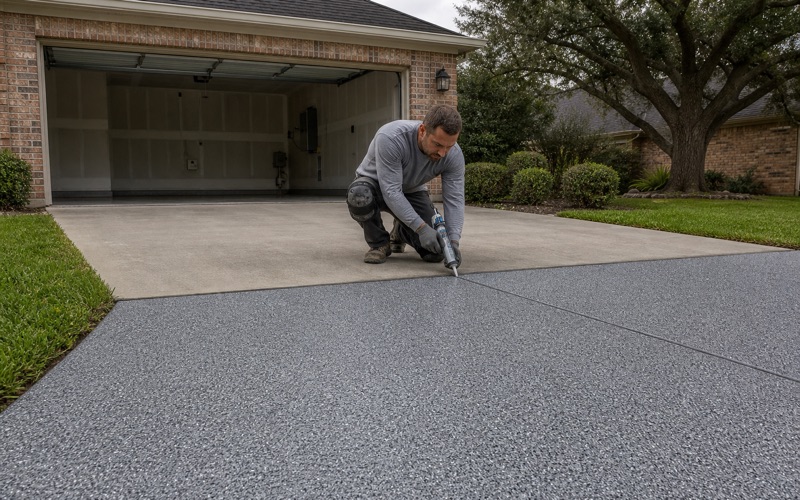
Killeen Epoxy Flooring has been putting down epoxy flooring in Serenada long enough to know most of what we will find before the garage door goes up, and that is unusual. Almost every house here was built inside the same two decades, which makes this the most predictable place we work.
88.8 percent of the housing stock went in during the 1970s and 1980s, split 40.8 percent to the 1970s and 48.0 percent to the 1980s, with nothing recorded before 1970 and nothing built since 2020. There is no older core near a downtown and no new subdivision on the edge. One cohort, aging together on the same schedule.
What that buys a homeowner is a contractor who is not guessing at the substrate. The same slab construction, the same service life and the same accumulated condition turn up address after address. What it does not settle is what sits under the slab, and that part of the picture is considerably less friendly.
Every garage the same age, and what that makes predictable
One cohort, wearing at the same rate
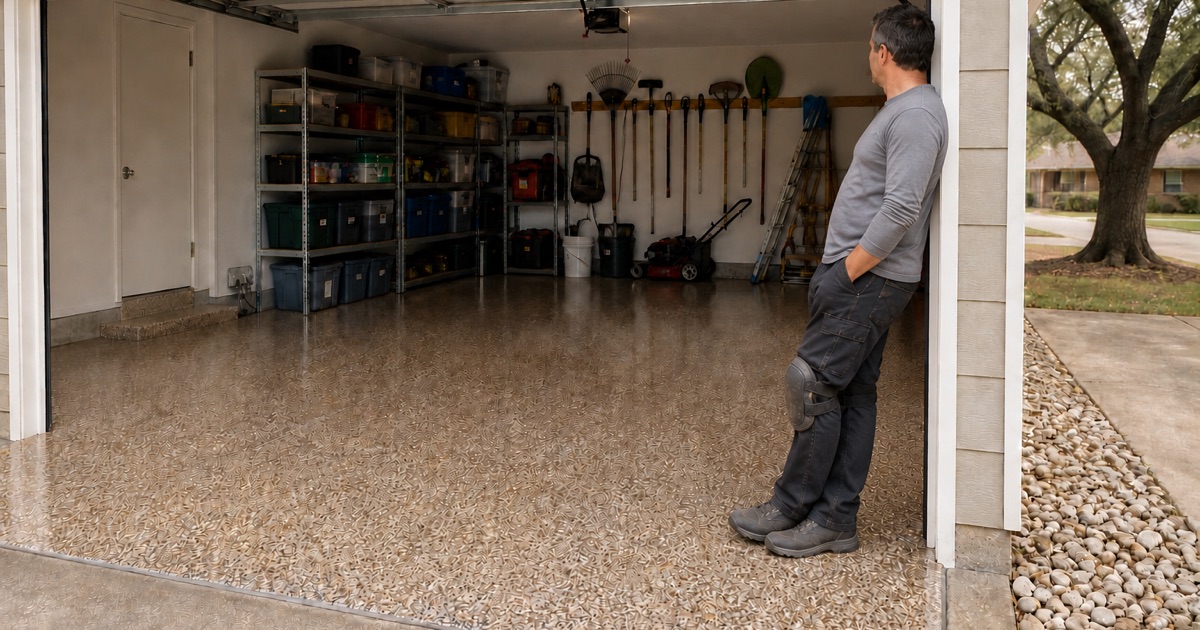
A place with fifty years of continuous building hands a contractor five different substrates. This one hands over a single cohort. Concrete placed in the 1970s and 1980s has had roughly the same length of service, the same generation of finishing practice behind it, and the same span of years to collect oil, tire marks and whatever a previous owner emptied out onto it.
The condition we find is therefore repeatable rather than novel. A hard troweled skin that has to be opened, surface carbonation, staining along the edge where a vehicle has parked in the same spot for two decades — these recur here in a way they do not in a mixed-age town, and we scope for them from the outset instead of discovering them.
The geometry belongs to the same cohort
Garage layouts followed the same schedule as the houses. The transitional two-car attached bay of that era is shallower and narrower than a modern three-car, with door openings and side clearances current equipment simply cannot assume. A machine that fits one bay here has a good chance of fitting the next one, which is not true in most places.
That lets us quote this stock with more confidence than most, but it does not let us skip the tape measure. Predictable is not identical, and a homeowner who widened a bay or poured an apron somewhere in the intervening decades has changed the job in a way no housing table anywhere records.
What we verify at every address anyway
Uniformity is a reason to be efficient, not a reason to skip steps. Every quote still begins with what the slab is sitting on, what is already bonded to its surface, and whether the concrete is holding moisture. Those three answers decide the crack detail and the system build far more than the name on the pail does.
This is also a small enough place that the published figures deserve a caveat we would rather give than hide. The unit estimates here carry a margin of error around 21 percent, so the shares are dependable in direction while the counts underneath them are soft. We will quote you a floor, not a statistic.
Looking for epoxy flooring closer to Lampasas? See Epoxy Flooring in Lampasas.
A stony surface over clay that the surface does not advertise
What the soil survey actually calls this ground
The map unit under this place is a stony clay loam on 1 to 3 percent slopes, making up about 90 percent of the unit and classified as a well-drained Udic Paleustoll in the very-fine family. The family designation is the part that matters to a slab: very-fine means more than 60 percent clay in the control section.
Nothing at the surface advertises that. A stony clay loam underfoot reads as ordinary well-drained ground, and it does drain genuinely well. The clay is below, out of sight, and it is the reason a slab here behaves the way it does across a wet spring and a dry August.
The layer the slab bears against
The top 17 centimeters carry 30 percent clay, a plasticity index of 23 and linear extensibility of 2.5 percent — moderate, unremarkable numbers that would not worry anyone. From 17 to 89 centimeters the profile jumps to 70 percent clay, a plasticity index of 48 and linear extensibility of 8.5 percent. That is high shrink-swell, and it is the horizon a slab bears on.
The minor components confirm the reading rather than soften it. Tarpley sits at about 5 percent of the unit, Eckrant at about 3 and Fairlie at about 2, every one of them smectitic and Fairlie a true Vertisol. So we tell a homeowner here exactly what a coating is: a bonded film a few thousandths of an inch thick that follows the slab underneath it, and nothing we install will stop or bridge seasonal ground movement.
Rock at roughly thirty-five inches, and where the water goes
Below 89 centimeters the survey returns no clay, plasticity or extensibility figures at all, which is the signature of a bedrock contact at roughly 35 inches. Two of the three minor components are Lithic, meaning shallow to rock. This is a thin profile sitting on stone rather than a deep column of soil.
That creates a drainage condition worth understanding before a floor is specified. Water reaching the rock has nowhere to percolate down to and moves laterally instead, which concentrates moisture at slab depth. Moisture pushing up through concrete is what lifts a coating off it, and here that is a more likely failure mode than any visible crack.
A slab that could be either side of the post-tension transition
Establishing slab type before anything gets cut
Post-tension slabs became common in Texas after about 1980, and this place sits directly on that line. The 1970s portion of the stock, a little over 40 percent of it, predates the transition and is conventionally reinforced ground-supported concrete. The 1980s portion, nearly half of everything standing here, straddles it.
Slab type is therefore genuinely ambiguous, and we establish it rather than assuming in either direction. Cutting or coring into a post-tension slab risks a tendon and there is no visual tell from the surface. On a plain floor coating that rarely comes up; it comes up the moment a drain, a threshold or an anchor enters the scope.
Cracks treated as joints that are still working
On ground that moves seasonally we do not fill a crack hard and coat straight over it. A working crack is routed out and filled with a semi-rigid polyurea joint filler, then carried through the finished floor as a joint that is allowed to keep moving, and you are told before the job is sold that it can telegraph again.
That is a less satisfying answer than a permanent repair and it is the honest one on this profile. Warranty exclusions get read out before anything is signed, with substrate movement and moisture named first, so that nothing about how the floor behaves in its third dry summer arrives as a surprise.
Moisture testing before the coating, not after the blister
Given what the water does at the rock contact, moisture testing on an older slab goes into the scope as a line item rather than being sold as an extra once a floor has blistered. Slabs from this cohort were frequently poured without an effective vapor retarder, and good drainage at the surface tells you nothing at all about that.
ASTM F1869 calcium chloride testing measures the vapor emission rate at the surface, ASTM F2170 probes read relative humidity inside the slab itself, and ASTM D4263 is a fast plastic sheet screen. We read the results against the ASTM F710 thresholds, and where a slab is over them we price a moisture-mitigation primer into the build rather than gambling on it.
Talking to the person who lives in the house, every time
There is effectively no landlord segment here
97.9 percent of occupied units in this place are owner-occupied and 96.9 percent of the stock is single-family detached, with owner-occupied detached houses accounting for 94.7 percent of everything occupied. There is no institutional operator, no property management layer and effectively no absentee decision-maker anywhere in the picture.
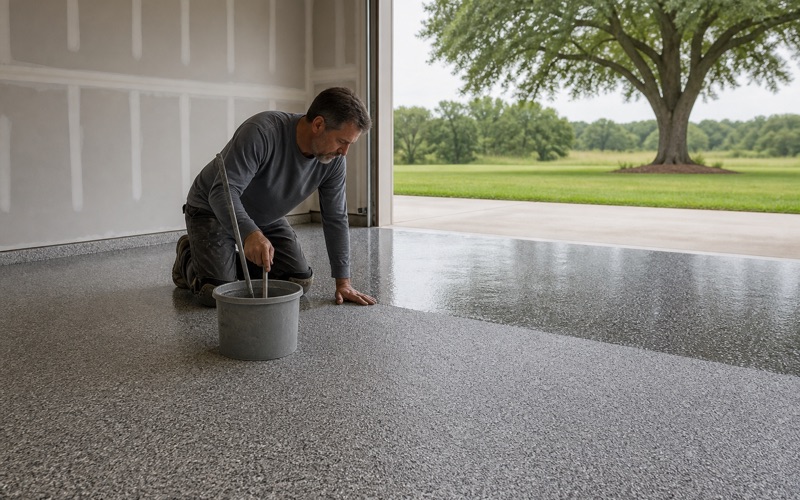
That changes the sale itself. Nobody here is buying a floor to survive a tenant move-out against a deadline; they are buying one they will look at every day for a decade. So the conversation runs to finish and gloss level, vinyl flake or quartz aggregate broadcast, and how the surface cleans — and it is had with the person who will live with the answer.
What the proposal has to name
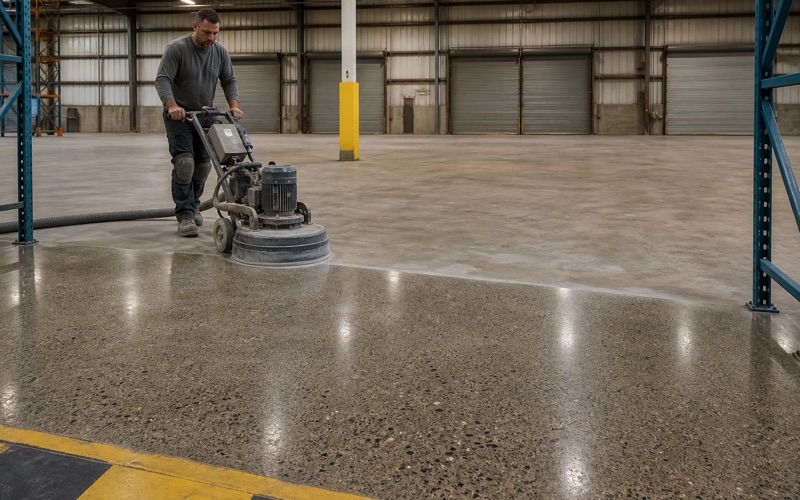
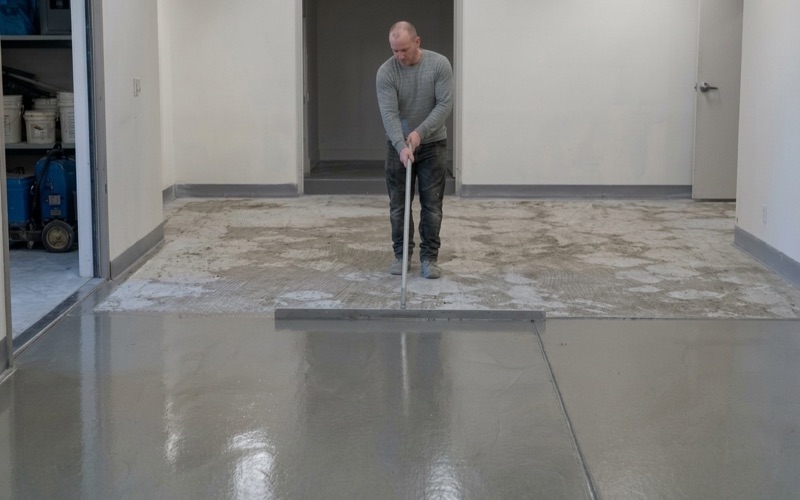
Because the buyer is the occupant, the proposal has to be checkable by somebody who does not do this for a living. Ours names the product, the system build and the finished mil thickness, so what you were quoted can be held against what went down. Every slab is opened mechanically with a grinder or a shot blaster to an ICRI CSP profile; we do not acid etch, and we do not put a new coating over an old sealer.
Texas licenses no flooring contractor, so there is no license number for us to quote you. What we show instead is a City of Killeen general construction registration, general liability cover, workers’ compensation and a Texas sales and use tax permit, and we would rather hand those over unasked than be asked for a credential that does not exist.
Unincorporated ground, and who the counterparty is
This is a census-designated place rather than a municipality. There is no city government, no mayor, no city council and no municipal building department, because the boundary is a Census Bureau statistical line rather than an act of incorporation. Williamson County is the local government here, reachable on its main line at 512-943-1100.
The county’s own structure tells you what is regulated and what is not. Development Services and Drainage covers land development and floodplain, Environmental Services administers on-site sewage facilities, and the Fire Marshal’s Office issues construction permits and carries out annual inspections. On a job that needs a construction permit the fire marshal is the likelier counterparty than a building official, and if a slab needs structural repair before it can be coated, we will say so.
- 20+ Years Experience
- Insured & City Registered
- Free Estimates